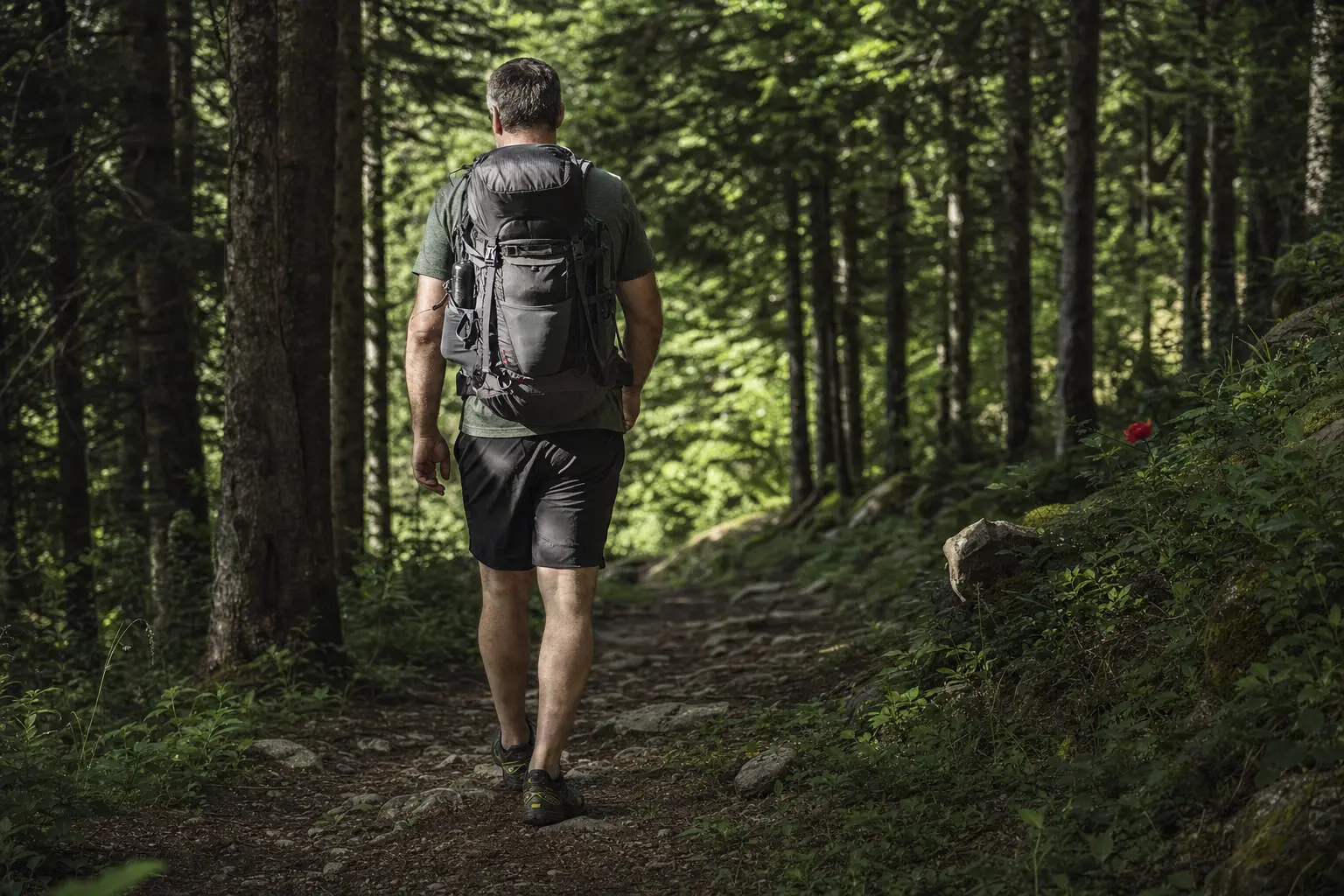
 AI-generated image
Guides · Strength training · Updated 2026-11-09
What is rucking, and how do you start?
Rucking is walking with a weighted backpack. It started as military training, and it turns an ordinary walk into a harder workout for your legs and back without any running. Start light, with an empty pack or about 5 pounds, and raise just one thing each week, such as the weight or the time, by about 10 percent.
- Walk without weight first. If you're new to exercise, build up to a 30-minute walk without a pack before you add any weight.
- Start with 5 to 10 pounds. Books or water bottles in a sturdy backpack work fine. Fit people can start nearer 10 percent of body weight.
- Pack it high and tight. Keep the weight close to your back and snug so it doesn't swing. Use the hip belt if your pack has one.
- Add one thing at a time. Raise the weight or the time by about 10 percent a week, one at a time, never both at once. Once or twice a week is a good start.
What rucking is
A ruck is a backpack, and rucking is walking with one that has weight in it. Soldiers have long trained this way to get used to carrying gear in the field. As a workout it sits between walking and hiking: you can do it on any street or trail, and the pack makes your legs and back work harder.
Cleveland Clinic sports medicine doctor Matthew Kampert says it is generally safe for people of all ages and fitness levels, unless you have painful bone or joint problems.
How many calories rucking burns
The 2024 Compendium of Physical Activities, the research list of what activities cost, rates a moderate walk on flat ground (2.8 to 3.4 mph) at 3.8 METs. Walking up hills with a pack is much higher. Here’s what an hour works out to:
| Body weight | Flat walk, no pack | Hills, 10 to 20 lb pack | Hills, 21 to 40 lb pack |
|---|---|---|---|
| 130 lb (59 kg) | About 225 calories | About 385 calories | About 440 calories |
| 160 lb (73 kg) | About 275 calories | About 470 calories | About 545 calories |
| 200 lb (91 kg) | About 345 calories | About 590 calories | About 680 calories |
Hills do a lot of that work. On flat ground, the pack itself adds less than people expect. A 2022 US Army equation built from people walking with packs shows that a pack weighing 10 percent of your body weight raises the energy you spend walking (on top of what you’d burn at rest) by about 9 percent. A pack at 20 percent of body weight raises it by about 22 percent, and one at 30 percent by about 38 percent. So to burn more, add hills or walk faster before you pile on weight.
These are estimates. Our rucking calorie calculator works it out for your weight, load and time.
How heavy to go
- New to exercise: walk without a pack until 30 minutes feels easy.
- Starting out: 5 to 10 pounds, or about 10 percent of body weight if you’re already fit.
- Building up: raise one thing at a time by about 10 percent a week. For example, 5 pounds to 5.5, or 30 minutes to 33.
- A speed goal: a 20-minute mile with your pack on is a common target.
Military loads can be far heavier. Soldiers train for them with regular marches, and injuries become more common as loads get heavier and marches get longer.
How to pack and carry it
A review of decades of Army research found that weight carried close to your body’s center costs the least energy and keeps you upright, much like normal walking. High placement in the pack suits even ground, and low or mid-back placement can help on rough trails. Hip belts take pressure off the shoulders. Weight on your feet is the costliest of all: each kilogram added to the feet raises energy use 7 to 10 percent, so wear light, comfortable shoes rather than heavy boots for everyday rucks.
For weight, use what you have: books, water bottles, canned food or a bag of sand. Wrap it so it doesn’t shift, and put it high and close to your back. A plate made for a ruck pack works too.
Common problems and how to avoid them
The same review lists the usual load-carrying injuries: foot blisters, stress fractures, back strain, knee pain and pain in the ball of the foot. Most come from doing too much too soon. To stay clear of them:
- Build up slowly. Add weight or distance a little at a time.
- Look after your feet. Good socks and broken-in shoes prevent most blisters.
- Watch your shoulders and neck. They take much of the strain. Tighten the straps and use the hip belt.
- Rest between rucks. Start with once or twice a week.
Who should check with a doctor first
Talk to your doctor first if you have a back or neck injury or chronic pain. The same goes for heart conditions. If you’re pregnant, check with your doctor and keep the weight light. Stop if you feel sharp pain, and rest until it’s gone.
Also asked
How much weight should I ruck with?
Start with about 5 to 10 pounds, or an empty pack if you're new to exercise. If that feels too easy and you're already fit, try about 10 percent of your body weight. Add weight slowly, by about 10 percent a week.
How many calories does rucking burn?
More than walking at the same speed. For a 160-pound person, an hour of hill walking with a 10 to 20 pound pack burns about 470 calories in the standard activity tables, against about 280 for a moderate walk on flat ground. Our rucking calorie calculator works it out for your weight, load and time.
Is rucking bad for your back or knees?
Not when you build up slowly. The injuries tied to load carrying, such as blisters, stress fractures, back strain and knee pain, mostly come from heavy loads and long distances. Start light and stop if something hurts.
How often should I ruck?
Start once or twice a week with 15 to 20 minutes. Work up to every other day if you enjoy it, with normal walks or rest on the days between.
Is a weighted vest the same as rucking?
Close enough. Rucking usually means a backpack, but a weighted vest spreads the load over your chest and back and works the same way. Start light with either.
Is rucking better than running?
It's different. Rucking is lower impact and easier to start, and the weight works your back and shoulders. Running usually burns more per minute. Both count as cardio, so pick the one you'll keep doing.
Sources
- Cleveland Clinic, Should you add rucking to your workout? (Matthew Kampert, DO)
- WebMD, What is rucking? (medically reviewed by Tyler Wheeler, MD)
- Knapik et al. (2004), Soldier load carriage, historical, physiological, biomechanical, and medical aspects
- Looney et al. (2022), Modeling the metabolic costs of heavy military backpacking
- 2024 Adult Compendium of Physical Activities, walking