 AI-generated image
Guides · Strength training · Updated 2026-11-01
How do you do a farmers carry, and how much weight should you use?
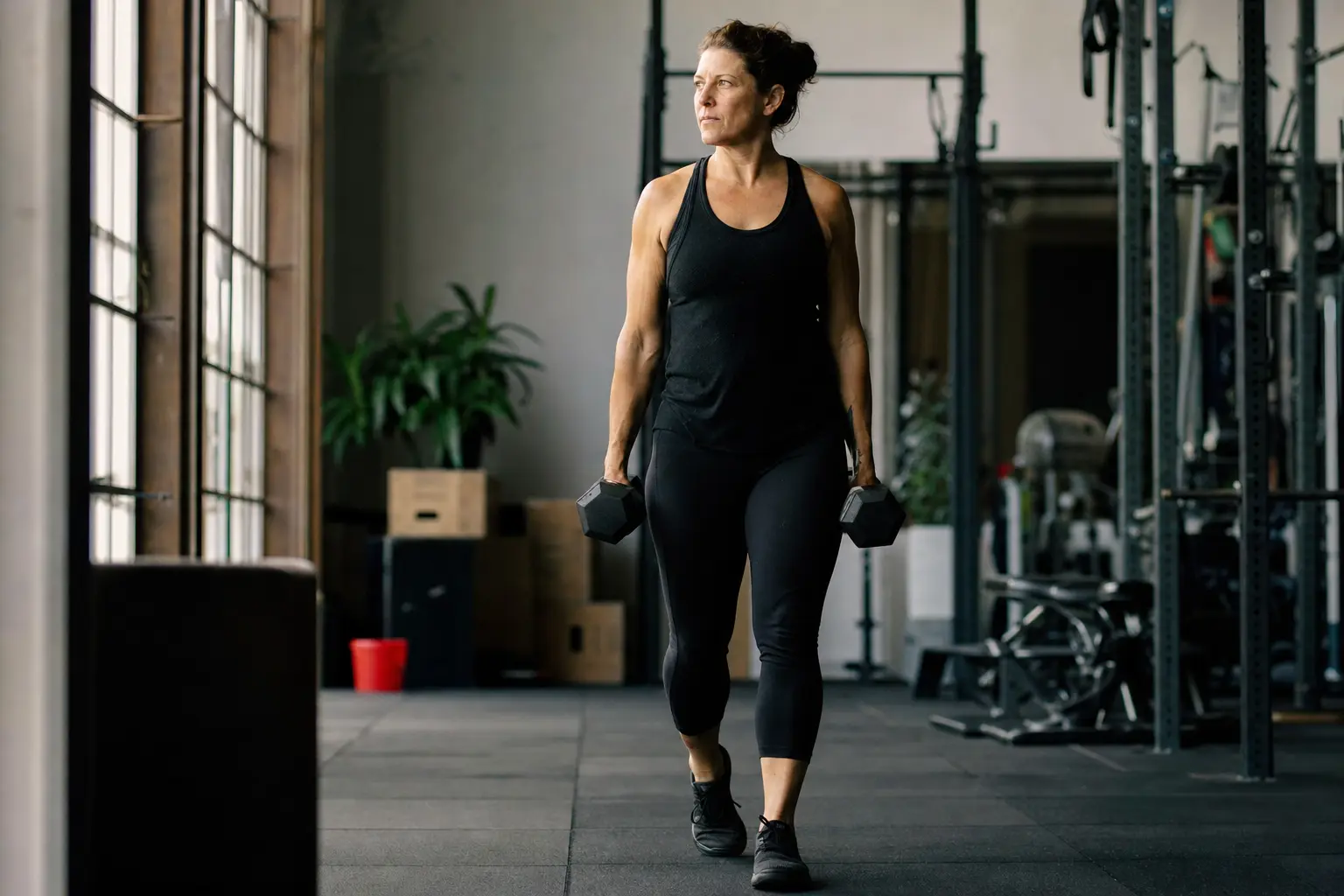
Hold a heavy weight in each hand and walk with short, steady steps for a set distance or time, standing tall the whole way. Start with a weight you can carry for about 30 seconds without leaning or shrugging, and add weight once every trip feels solid. One coaching benchmark is to carry half your body weight for 30 seconds, then work toward your full body weight. No gym? Two loaded grocery bags or water jugs work too.
- Set the weights by your feet. Put a weight on each side of you, close to your feet. Make sure you have room to walk at least 10 steps in a straight line.
- Pick them up like a deadlift. Bend at your hips and knees to grab both handles, then stand up with a flat back. Don't round over to reach them.
- Stand tall. Arms long at your sides, shoulders down and back, chest up, belly tight. Look straight ahead, not at your feet.
- Walk. Take short, steady steps for your set distance or time. Keep your hips level and don't let the weights swing or bump your legs.
- Set them down with control. Brace, then lower the weights the way you picked them up. Rest 1 to 3 minutes before the next trip.
What a farmers carry is
A farmers carry, also called a farmers walk, is the simplest loaded carry: hold a heavy weight in each hand and walk. Coaches program it for a set distance or a set time. Dumbbells are the usual choice, but kettlebells or special carry handles work too.
It looks easy, and that’s the point. Your hands have to hold on and your upper back has to keep your shoulders from sagging. Meanwhile your core and hips keep you upright with every step. Researchers at the University of Waterloo measured the muscles and spine loads in strongman events. They found that the carrying events challenged the body differently than the lifting events, and suggested that carries would make a regular lifting plan better.
How much weight to use
Start lighter than you think. Pick a weight you can carry for about 30 seconds while you stand tall, with no leaning or shrugging. If your posture breaks before the time is up, the weight is too heavy for now.
A coaching guide cited by the NSCA (the National Strength and Conditioning Association) suggests 2 to 4 rounds of 10 to 20 seconds with a weight that feels hard. The same authors give goals for a 30 second carry:
| Level | Weight carried for 30 seconds |
|---|---|
| Rebuilding after an injury | Half your body weight |
| General fitness | Your full body weight |
| Elite sport | Twice your body weight |
These are long-term goals, not where to begin. The NSCA article notes that there’s little research on carries, so these numbers come from coaching experience rather than studies.
To move up, change one thing at a time. Add a little weight, or keep the weight and walk a bit longer. Our guide to progressive overload covers how to keep making things a little harder, and how much weight should I lift helps with your other lifts.
The suitcase carry: one hand at a time
A suitcase carry is a farmers carry with a weight in one hand only. The weight tries to pull you sideways, so the muscles along your sides have to work hard to keep you straight. The NSCA article suggests starting with the two-hand version and moving on to suitcase carries once that feels solid.
Go lighter than you would with two hands. In a study from the same Waterloo lab, people carried buckets. Carrying 30 kg (66 lb) in one hand put more load on the low back than splitting it 15 kg per hand. It was even more than carrying 30 kg in each hand, double the total weight.
How heavy can a suitcase carry get? A 2018 study tested 51 active adults aged 18 to 45. They started at 10% of their body weight in one hand and added 10% each round until they started to lean or stumble. The most they carried with good form was about 53% of body weight for women and about 64% for men, on average. Those were 20 second maximum tests, so your training weight should sit well below that. Starting near 10% of your body weight is a sensible first step, and the study is a fair guide to how far you can build.
No gym? Carry what you have
You don’t need dumbbells. Anything with a handle that you can grip and keep level will do:
- Grocery bags. Load two bags evenly with cans or bottles. Double-bag them so they don’t tear.
- Water jugs. Fill two jugs as full as you need. Partly full jugs slosh, which makes it a little harder.
- Buckets. Fill two buckets with water or sand. This is what the Waterloo study used.
- A single bag. For a suitcase carry, one heavy bag in one hand is all you need. Switch hands each trip.
Keep the two sides close to the same weight for a farmers carry. Walk laps of the yard or up and down a hallway. If the handles dig in, wrap them with a small towel.
Form tips
- Pick up and set down with care. Lift the weights from the floor the way you would deadlift: push your hips back and keep your back flat as you stand. A sloppy pickup is an easy way to strain your back.
- Stand tall. Shoulders down and back, chest up, belly tight, eyes ahead. Don’t lean back to balance the weights.
- Take short steps. Short, steady steps keep the weights from swinging. Walk slow and controlled.
- Keep your hips level. For a suitcase carry, don’t lean away from the weight or let your hip drop.
If your grip gives out first, that’s normal. Set the weights down and rest before the next trip. Stop if you feel sharp pain in your back or shoulder.
Where carries fit in your week
The NSCA article suggests two good spots: at the start of a workout to wake up your body, or at the end as a short burst of conditioning. A few trips at the end of a workout is plenty to start. Carries fit well into a full-body workout and are a good choice for strength training over 50, because carrying things is part of everyday life.
For a harder hold on your core without moving, see how long to hold a plank. For the same kind of full-body push with your legs, see the sled push.
Also asked
How heavy should a farmers walk be?
Start with a weight you can carry for about 30 seconds while standing tall. Coaches who wrote for the NSCA give goals for a 30 second carry: half your body weight when you're rebuilding and your full body weight for general fitness. For elite athletes, the goal is twice body weight. Add weight in small steps once every trip looks the same as the first.
How far or how long should a farmers carry be?
Either works. You can carry for a set distance or a set time. One coaching guide suggests 2 to 4 rounds of 10 to 20 seconds with a weight that feels hard. Rest 1 to 3 minutes between trips so your grip can recover.
What's the difference between a farmers carry and a suitcase carry?
A farmers carry has a weight in each hand. A suitcase carry has a weight in one hand only, so your sides have to work hard to keep you from leaning. Use less weight for a suitcase carry. In one study, carrying 30 kg (66 lb) in one hand loaded the low back more than carrying 30 kg in each hand.
What muscles does a farmers walk work?
Your grip and forearms, your upper back and shoulders, your core, and your legs and hips all work to hold you steady while you walk. Researchers who measured strongman events found that carrying asks different things of the body than lifting does, and suggested carries would add to a regular lifting plan.
Can I do a farmers carry at home without weights?
Yes. Carry two grocery bags, two water jugs, two buckets or two packed bags of the same weight. Keep the two sides even, and choose handles you can grip well. You can make it harder by filling them more or walking longer.
Is the farmers carry good for beginners?
Yes. It's one of the easiest exercises to learn, since it's mostly walking with good posture. A coaching article from the NSCA calls the two-hand farmers walk a good starting point for people who are out of shape or coming back from an injury, before moving on to one-hand carries.
Sources
- Taylor and Reed (2020), Increase hip and trunk stability with loaded carries (NSCA Coach 7.3)
- Holmstrup et al. (2018), Fat-Free Mass and the Balance Error Scoring System Predict an Appropriate Maximal Load in the Unilateral Farmer's Walk (Sports)
- McGill et al. (2013), Low back loads while walking and carrying: comparing the load carried in one hand or in both hands (Ergonomics)
- McGill et al. (2009), Comparison of different strongman events: trunk muscle activation and lumbar spine motion, load, and stiffness (Journal of Strength and Conditioning Research)
- Healthline, What are the benefits of the farmer's walk exercise? (written by an RD and CSCS, medically reviewed)