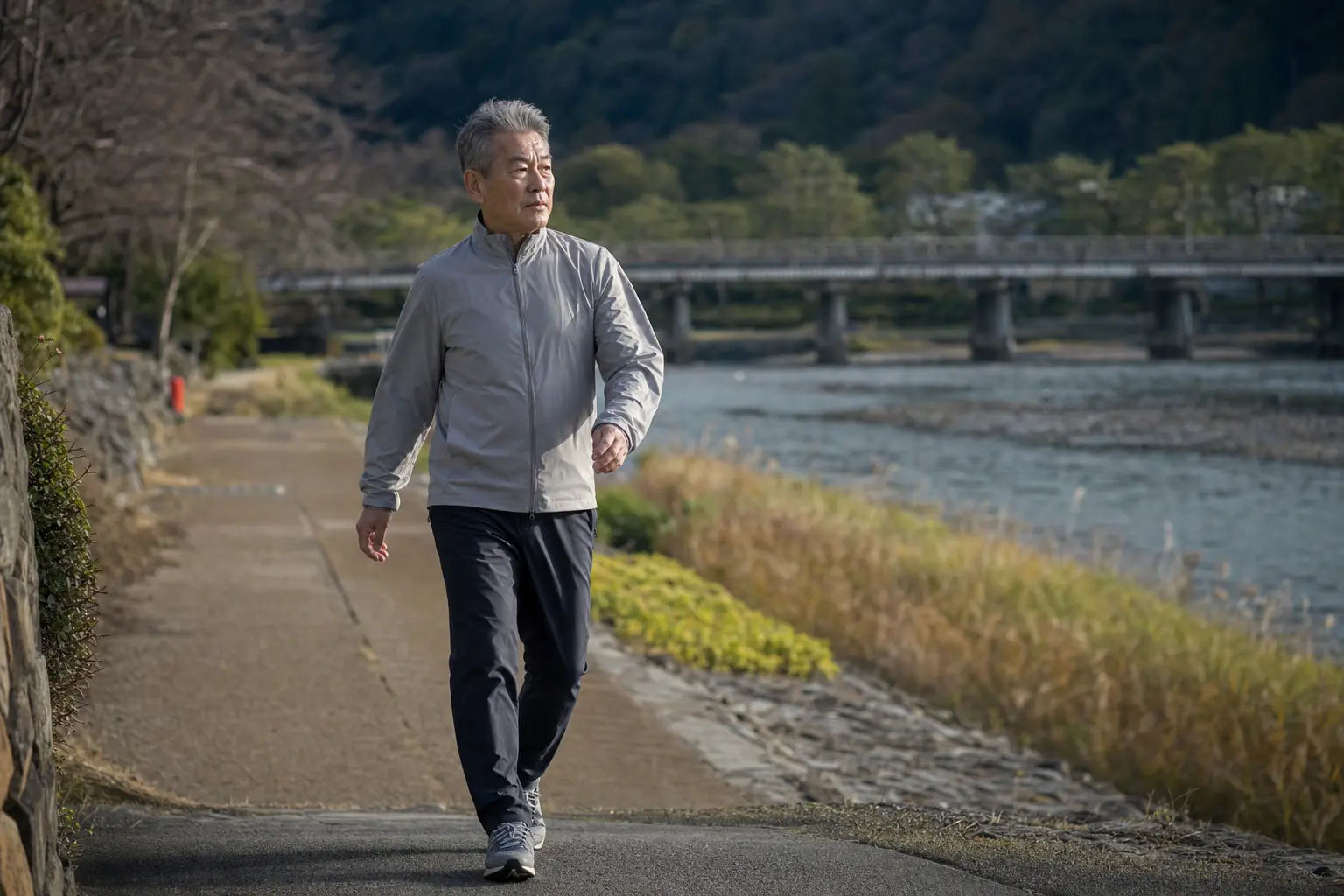
 AI-generated image
Guides · Strength training · Updated 2026-11-09
What is Japanese walking (interval walking), and does it work?
Japanese walking is interval walking training developed at Shinshu University in Japan: 3 minutes of fast walking, then 3 minutes of slow walking, repeated at least 5 times, on 4 or more days a week. In a 2007 trial of 246 adults with an average age of 63, five months of it built more thigh strength and fitness than steady walking did, and it lowered resting blood pressure more. All you need is a timer and a place to walk.
- Walk fast for 3 minutes. Walk as briskly as you can keep up for 3 minutes. It should feel hard, to the point where talking takes effort.
- Walk slowly for 3 minutes. Ease off to a relaxed stroll and let your breathing settle.
- Repeat 5 times. Five rounds of fast and slow is 30 minutes. If that's too much at first, do two or three rounds and add one each week.
- Do it 4 or more days a week. The studies asked for at least 4 days a week. Spread them out, and keep easy walking on the other days if you like.
Where it comes from
A research team at Shinshu University in Matsumoto, Japan, built interval walking training for middle-aged and older people. They wanted a plan that people would stick with for the long run and could do near home with little help from staff. Online it is now called Japanese walking, but in the research it is interval walking training.
The recipe has stayed the same across their studies: at least 5 rounds of 3 minutes fast and 3 minutes slow, on 4 or more days a week.
What the studies found
The 2007 trial. 246 adults with an average age of 63 trained for five months. The researchers compared interval walking with steady walking, which meant 8,000 or more steps a day at a moderate effort. A third group didn’t train. The interval group gained:
| Measure | Change with interval walking |
|---|---|
| Knee extension strength (front of thigh) | Up 13 percent |
| Knee flexion strength (back of thigh) | Up 17 percent |
| Peak fitness on a bike | Up 8 percent |
| Peak fitness when walking | Up 9 percent |
All of those gains were bigger than in the steady walking group, and resting systolic blood pressure dropped more too.
Larger follow-ups. A 2011 study of over 600 people found that four months of interval walking raised fitness and thigh strength, and lowered weight, body fat, blood pressure and blood sugar. The least fit people improved the most. A 2019 study of 679 people found that fitness rose about 14 percent on average over five months. The gains grew with the number of fast minutes a week, up to about 50 minutes, and then levelled off. The slow minutes didn’t add much.
Sticking with it. In a 22-month study of 696 people, participants managed about 70 percent of their target days on average, and those who kept at it saw the biggest gains. A 2024 review says people stick with it well in short studies, and that keeping it up for years is the hard part, as with any exercise.
Most of this research was in people around 60 to 65 years old in Japan. It is likely to help younger walkers too, but that is less studied.
How fast is fast?
The studies set the fast part at 70 percent or more of each person’s top walking effort, measured in a lab. You don’t need a lab. The CDC’s talk test is a good stand-in: at a moderate effort you can talk but not sing, and at a vigorous effort you can only say a few words before you need a breath. Aim for the fast minutes to feel hard, near that vigorous line. The slow minutes should feel easy enough to chat.
A quick check: if the fast part feels like a normal walk, speed up or find a gentle hill.
Calories
The 2024 Compendium of Physical Activities rates a moderate walk at 2.8 to 3.4 mph at 3.8 METs and a very brisk walk at 4.0 to 4.4 mph at 5.5 METs. For a 160-pound person, 30 minutes of walking between those two works out to about 140 to 200 calories. Our steps to calories calculator and cardio calorie calculator work it out for your weight.
Japanese walking vs other walking workouts
- Steady walking. Easier to keep up for long stretches. Good for daily steps and zone 2.
- Interval walking. Adds hard minutes in a short session. Better for building fitness and leg strength, going by the studies above.
- Incline walking. The 12-3-30 workout keeps the effort high by walking uphill the whole time.
- Rucking. Rucking adds weight in a backpack instead of speed.
Who should check with a doctor first
The fast minutes are real effort. Check with your doctor first if you have a heart condition or high blood pressure. Joint pain that gets worse when you walk is worth a check too. Stop and rest if you feel chest pain or dizziness.
Also asked
Why is it called Japanese walking?
The method comes from researchers at Shinshu University in Matsumoto, Japan, who call it interval walking training. They have tested it in large groups of middle-aged and older people since at least 2004. The nickname Japanese walking came later, online.
How fast is the fast part?
In the studies, it was at least 70 percent of each person's top walking effort, and the slow part was about 40 percent. In plain terms, the fast walk should feel hard, close to the point where you can only say a few words between breaths. The slow walk should feel easy.
Is Japanese walking good for weight loss?
It helps, but it isn't magic. In a 2011 study of over 600 people, body weight and body fat went down after four months, along with blood pressure and blood sugar. For real weight loss, pair it with eating a bit less.
How many calories does Japanese walking burn?
Roughly 140 to 200 calories in 30 minutes for a 160-pound person, from the standard activity tables for moderate and very brisk walking. A heavier person burns more and a lighter person less. Treat any number as an estimate.
Is Japanese walking better than 10,000 steps?
They do different jobs. Step counts measure how much you move. Interval walking adds hard minutes, and a 2019 study found that the fast minutes were what drove the gains in fitness. You can do both, since every interval walk adds to your step count.
Can I do Japanese walking on a treadmill?
Yes. Change the speed every 3 minutes, or raise the incline for the fast parts. Hold on lightly, if at all, so your legs do the work.
Sources
- Nemoto et al. (2007), Effects of high-intensity interval walking training on physical fitness and blood pressure in middle-aged and older people (Mayo Clinic Proceedings)
- Morikawa et al. (2011), Physical fitness and indices of lifestyle-related diseases before and after interval walking training in middle-aged and older males and females
- Masuki et al. (2015), The factors affecting adherence to a long-term interval walking training program in middle-aged and older people
- Masuki et al. (2017), Interval walking training can increase physical fitness in middle-aged and older people
- Masuki et al. (2019), High-intensity walking time is a key determinant to increase physical fitness and improve health outcomes after interval walking training
- Karstoft et al. (2024), Health benefits of interval walking training
- CDC, Measuring physical activity intensity (talk test and 0 to 10 scale)
- 2024 Adult Compendium of Physical Activities, walking