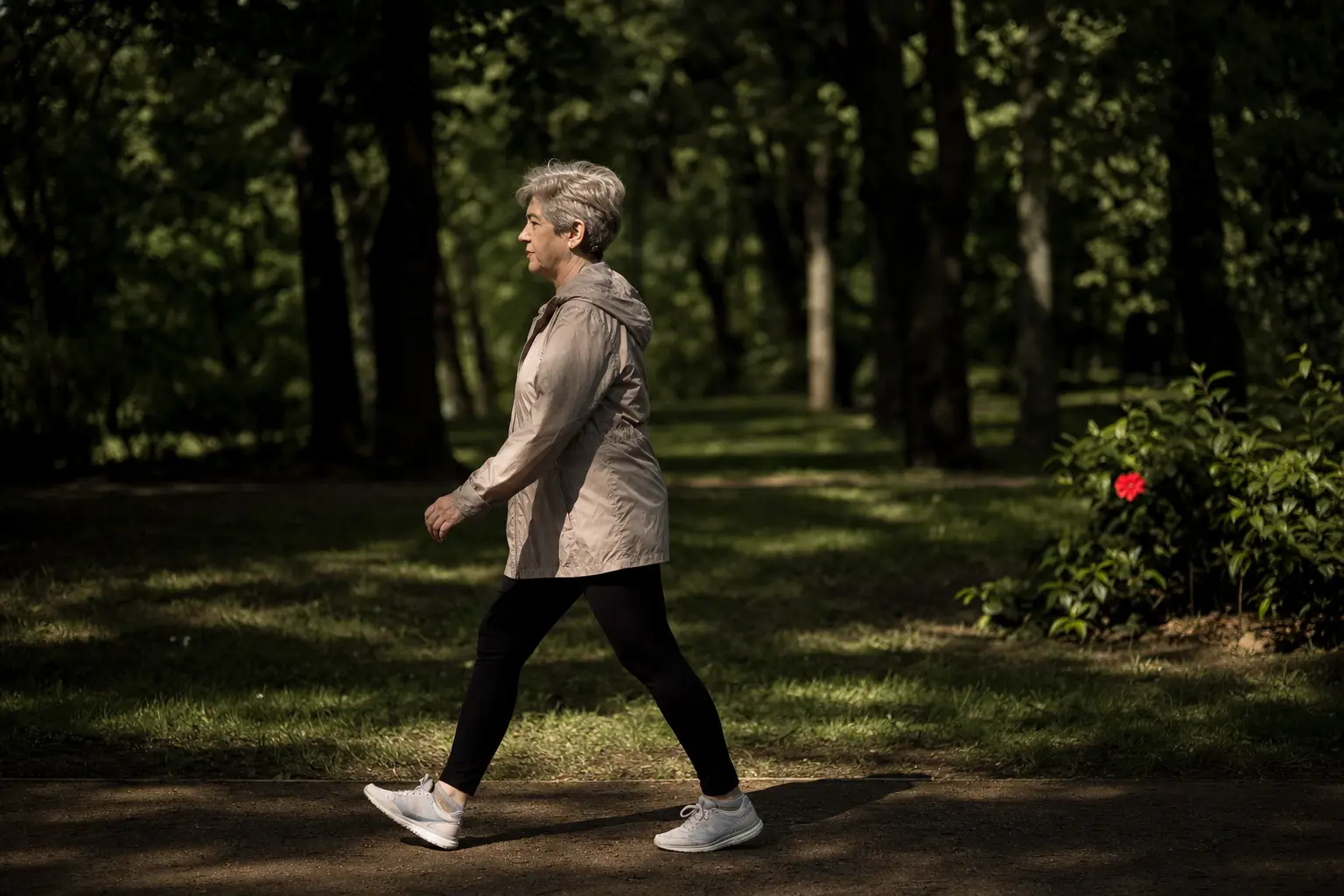
 AI-generated image
Guides · Running and cardio · Updated 2026-11-11
How many steps a day do I really need?
You don't need exactly 10,000. A 2022 analysis of 15 studies found the risk of early death kept falling as daily steps rose, then leveled off around 6,000 to 8,000 steps a day for adults 60 and older and around 8,000 to 10,000 for younger adults. If you're below that, adding even a couple of thousand steps a day is worthwhile. If your goal is to lose weight, working up to about 10,000 steps a day helps most when you pair it with a modest cut in calories.
What the research found
In 2022, researchers pooled 15 studies covering about 47,000 adults. People who took more steps a day had a lower risk of dying early, up to a point:
| Age | Where the benefit leveled off |
|---|---|
| Under 60 | About 8,000 to 10,000 steps a day |
| 60 and older | About 6,000 to 8,000 steps a day |
They didn’t find that walking faster added much on top of the number of steps.
How many steps a day to lose weight
There’s no single number, because weight loss depends mostly on how much you eat. But the research gives a useful target. The American College of Sports Medicine found that 150 to 250 minutes a week of moderate activity brings only modest weight loss on its own. More than 250 minutes a week is linked to meaningful weight loss. Studies that followed people after weight loss also linked that much activity to keeping the weight off.
Two hundred and fifty minutes a week is about 36 minutes a day. Brisk walking starts at about 100 steps a minute, so that’s at least 3,600 brisk steps a day on top of your normal moving around. For many people, a daily goal of about 10,000 steps covers it.
Here’s roughly what extra steps burn for a 160 lb person walking at 3 mph, counting only the calories on top of what they’d burn sitting still:
| Extra steps a day | Extra calories a day, about | Extra calories a week, about |
|---|---|---|
| 2,000 | 70 | 475 |
| 4,000 | 135 | 955 |
| 6,000 | 205 | 1,430 |
| 10,000 | 340 | 2,385 |
Heavier people and faster walkers burn more. Try your own numbers in the steps to calories calculator.
Steps work best with eating a little less
Walking makes a calorie deficit easier, but it rarely creates a big one by itself. In the same review, moderate activity helped people lose more weight when they also ate a little less, but added little on top of a very strict diet. So pair your steps with a modest cut. How many calories to eat to lose weight walks through the numbers.
Don’t eat below about 1,200 calories a day for women or 1,500 for men without a doctor’s help, even on days with lots of steps. If you have a history of an eating disorder, or counting steps or food starts to feel stressful or controlling, work with a doctor or registered dietitian instead of setting a goal on your own.
How to build up your steps
Check your phone or watch for your average over the last week. That’s your starting point. Healthy adults usually take somewhere between 4,000 and 18,000 steps a day, so there’s no “normal” to match.
Then add about 2,000 steps a day, which is about what people add in step-count studies. Hold that for a couple of weeks, then add another 2,000 if you want to. Small steps up are easier to keep than a jump to 10,000.
How long does it take to walk 10,000 steps?
About an hour and a half at an everyday pace. In a study of adults walking on a treadmill, someone about 5 ft 7 in tall walking at 3 mph would cover 10,000 steps in about 88 minutes, or about 4.4 miles. You don’t need to do it in one go. Steps from your whole day count.
Easy ways to add steps
- Take a 10-minute walk after meals.
- Walk during phone calls.
- Park further away, or get off a stop early.
- Take the stairs for a floor or two.
Make it count as exercise
For a cardio workout, walk briskly enough that you can talk but not sing. That’s moderate intensity, and it counts toward the US guideline of 150 to 300 minutes a week.
Also asked
Where did 10,000 steps come from?
It's a round number that became popular decades ago, before most of the research. It's a fine goal, but the benefits start well below it.
Does walking help with weight loss?
Walking burns calories and is easy to keep up, so it helps. Weight loss still depends mostly on how much you eat.
Do steps count as exercise?
Brisk walking counts toward the 150 to 300 minutes of moderate activity a week in the US guidelines. Slow strolling helps less but still beats sitting.
How many steps a day to lose weight?
There's no magic number, but about 10,000 a day, with at least half an hour of it brisk, is a reasonable goal for most adults. It adds up to the 250 or more minutes a week of moderate activity that the American College of Sports Medicine links to meaningful weight loss. Pair it with a modest calorie cut.
How many calories does walking 10,000 steps burn?
About 450 calories for a 160 lb person of average height walking at 3 mph. About 340 of those are on top of what you'd burn sitting still. Heavier people and faster walkers burn more.
Is walking 10,000 steps a day enough to lose weight?
It can be, if what you eat stays the same or drops a little. If you eat more to make up for it, the scale may not move. Walking alone usually brings only modest weight loss.
How many steps is a 30-minute walk?
At least 3,000 if you walk briskly. Research puts the start of moderate-intensity walking at about 100 steps a minute.
Sources
- Paluch et al. (2022), Daily steps and all-cause mortality, a meta-analysis of 15 international cohorts
- US Department of Health and Human Services, Physical Activity Guidelines for Americans
- Donnelly et al. (2009), American College of Sports Medicine Position Stand, Appropriate physical activity intervention strategies for weight loss and prevention of weight regain for adults
- Tudor-Locke et al. (2011), How many steps/day are enough? For adults
- Tudor-Locke et al. (2019), Walking cadence (steps/min) and intensity in 21 to 40 year olds, CADENCE-Adults
- Harvard Health Publishing, Calorie counting made easy