 AI-generated image
Guides · Strength training · Updated 2026-11-09
What is a Zercher squat, and how do you do it?
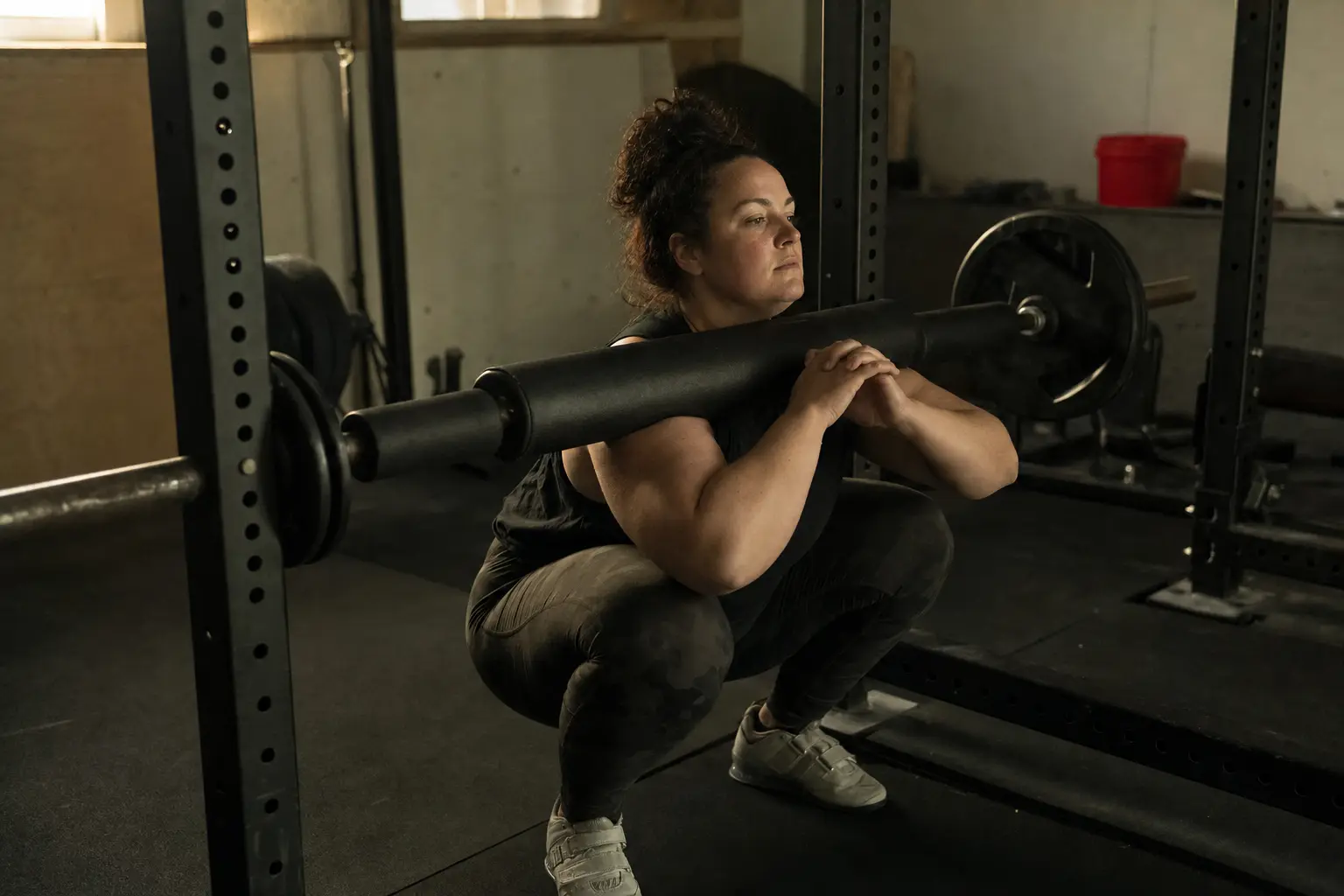
A Zercher squat, named after 1930s lifter Ed Zercher, is a squat with the barbell held in the bend of your elbows. Set the bar in a rack at about stomach height and hook your arms under it. Then squat down with your chest up and stand back up. Start light and pad the bar, because it presses into your arms.
- Set up the rack. Set the bar at about the middle of your stomach. Put the safety bars just below the lowest point of your squat. Wrap the middle of the bar in a pad or a folded towel.
- Hook the bar in your elbows. Bend your arms and slide them under the bar so it sits in the crease of your elbows. Clasp your hands together or make two fists in front of your chest.
- Lift it off and brace. Stand up to lift the bar off the hooks, then take two small steps back. Set your feet about shoulder-width apart. Breathe into your belly and tighten your core.
- Squat down. Sit your hips down between your heels with your chest up. Let your elbows travel down between your knees. Go as low as you can while your back stays flat.
- Stand up. Push the floor away through your whole foot. Keep your arms pulled up toward your chest so the bar doesn't slide down your forearms.
What a Zercher squat is
A Zercher squat is a squat where you hold the barbell in the crook of your arms instead of on your back. A history of the lift from the United States All-Round Weightlifting Association calls it “a front squat with the bar held in the crook of your arms.” It’s named after Ed Zercher, who competed in the 1930s.
Because the weight sits in front of you, your upper back and core have to work hard to keep your chest up. Your legs and hips do the same job they do in any squat.
Common mistakes, and fixes
| Mistake | Try |
|---|---|
| The bar digs into your arms | Wrap it in a pad or towel. Drop the weight for a few weeks while your arms get used to it |
| Your upper back rounds forward | Pull your arms up toward your chest and use a lighter weight |
| Your elbows hit your knees at the bottom | Widen your stance a little so your elbows fit between your knees |
| The bar slides toward your hands | Bend your elbows more and keep your fists close to your chest |
Easier and harder versions
- Easier: goblet squat. Hold one dumbbell or kettlebell at your chest. It teaches the same upright position with nothing pressing on your elbows.
- Easier: Zercher box squat. Squat down to a box or bench set at the depth you want, then stand. The box tells you when to stop.
- Harder: paused Zercher squat. Hold the bottom position for two seconds before you stand. Use less weight.
- Harder: Zercher squat with more weight. Once your form is steady, add small jumps in weight each week.
Sets and reps to start with
Start with 2 sets of 8 to 12 reps, two days a week. A 2026 position stand from the American College of Sports Medicine (ACSM) advises at least two sets per exercise and training at least twice a week, and notes that past guidelines used 8 to 20 reps per set.
Pick a weight you could lift for a couple more reps than you do. The ACSM’s 2009 guide suggests adding 2 to 10% when you can do one or two reps more than your target. Our guide to progressive overload covers how to keep making it a little harder.
Safety
Squat inside a rack with the safety bars set just below your lowest point. If you can’t stand up, sit down and let the bar rest on the safeties. Warm up with the empty bar. Stop if you feel sharp pain anywhere, especially at the elbows or in your back.
For more lower-body work, see the Nordic hamstring curl for the backs of your legs and the farmers carry for your grip and upper back.
Also asked
What is a Zercher squat good for?
It trains your legs and hips like any squat. Holding the bar in front also makes your upper back and core work hard to keep you upright. It's useful if you can't hold a bar on your back or in the front rack, or if you want a squat that also builds your grip on awkward loads.
Why does the Zercher squat hurt my arms?
The bar sits right on the inside of your elbows, so some discomfort is normal at first. Wrap the bar in a pad or a towel and keep the weight light while you get used to it. A history of the lift from the United States All-Round Weightlifting Association says it can be very hard on the biceps tendons, and that a thinner bar puts more stress on them. Stop if you feel sharp pain at the elbow.
Is a Zercher squat harder than a front squat?
It's different more than harder. The bar sits lower and farther from your shoulders, so your upper back has more to do. The bar on your arms also limits how much you'll want to hold, so expect to use less weight at first.
Who was Ed Zercher?
Ed Zercher was a lifter who competed in the 1930s. A history from the United States All-Round Weightlifting Association reports that a magazine in December 1934 listed his two-hand deadlift record as 536 pounds. The Zercher lift and the Zercher squat both carry his name.
How heavy should I go on Zercher squats?
Start with the empty bar, or with a weight you could squat for at least 12 reps. Add a little weight when you can finish all your reps with good form and a rep or two to spare.
Sources
- LaPointe (2012), Zercher: A Lift and A Lifter (United States All-Round Weightlifting Association)
- Schoenfeld (2010), Squatting kinematics and kinetics and their application to exercise performance
- Currier et al. (2026), American College of Sports Medicine position stand: Resistance training prescription for muscle function, hypertrophy, and physical performance in healthy adults
- American College of Sports Medicine (2009), Progression models in resistance training for healthy adults