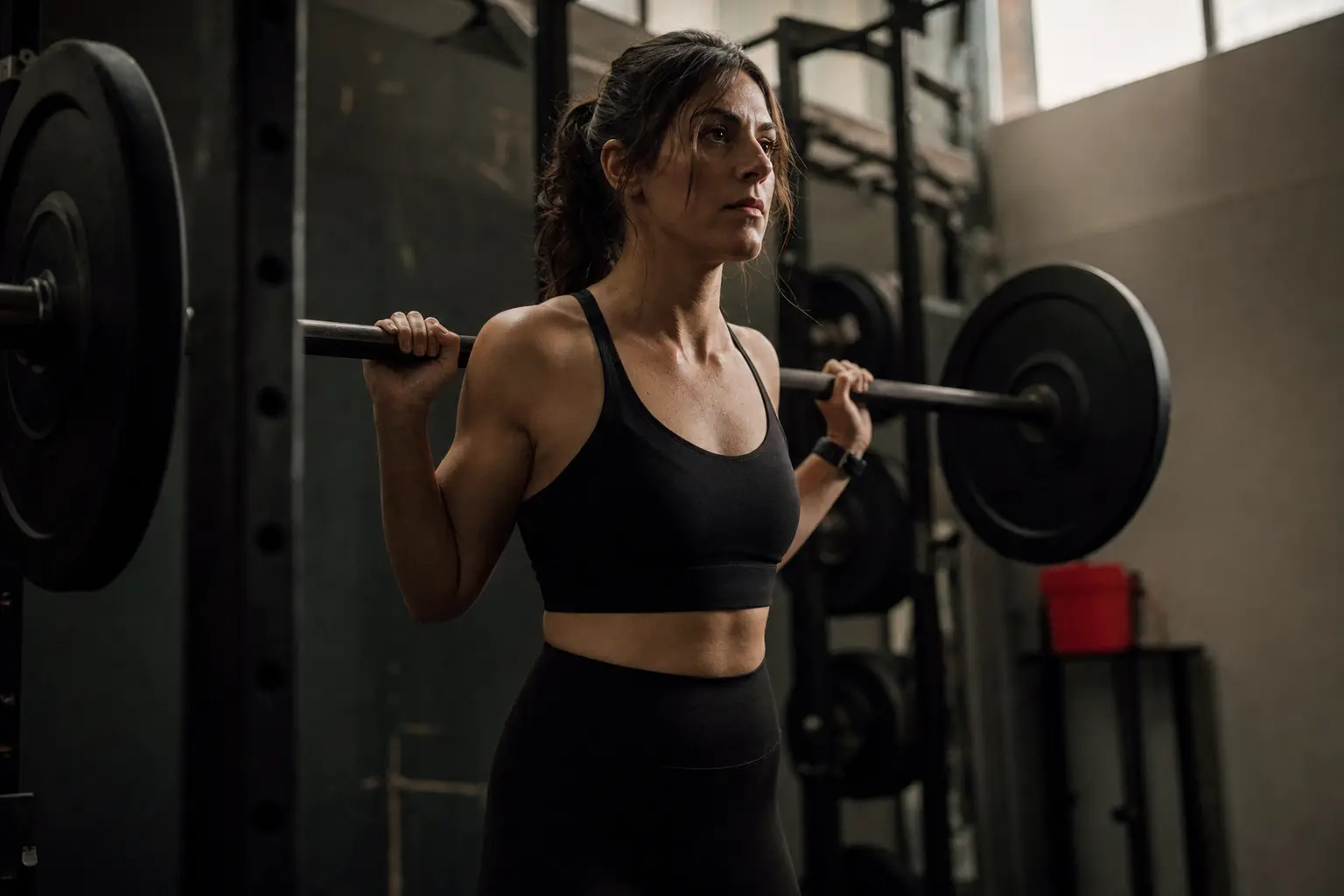
 AI-generated image
Guides · Strength training · Updated 2026-11-11
How do I do a squat with good form?
To do a squat, stand with your feet about shoulder-width apart and toes turned out slightly. Brace your core, then sit your hips down and back while your knees track over your toes, keeping your heels down and your back flat. Go as deep as you can while keeping that position, then drive up through your whole foot. Your knees can move past your toes; that's normal.
- Set your stance. Feet about shoulder-width apart, toes turned out 15 to 30 degrees. Find the stance where you feel balanced.
- Brace. Take a breath into your belly and tighten your core as if bracing for a light push.
- Sit down and back. Bend at the hips and knees together. Push your knees out in line with your toes as you lower.
- Find your depth. Go as low as you can with your heels down and your back flat. For many people that's thighs parallel to the floor or below.
- Stand up. Push the floor away through your whole foot, keeping your chest and hips rising together.
How to do a squat with just your body weight
If you’ve never squatted, start with no weight at all. Stand in front of a sturdy chair with your arms out in front of you. Sit back until you lightly touch the seat, then stand up without using your hands. When that feels easy, stop just above the chair. Then lose the chair and go as low as you can with good form. After that, hold a dumbbell at your chest for a goblet squat.
How to squat properly: a form check
| Body part | What to aim for |
|---|---|
| Feet | Flat on the floor, with your weight over the middle of your foot |
| Knees | Follow the line of your toes. Going past your toes is fine |
| Back | Flat and braced, with your chest up. Not rounded at the bottom |
| Depth | As low as you can go while your heels stay down and your back stays flat |
| Breathing | Breathe in and brace at the top, then breathe out as you stand |
Film one set from the side with your phone. It’s the fastest way to see your depth and your back.
Why your knees can go past your toes
Many people were taught to keep their knees behind their toes. A study tested that idea with a barrier that stopped the knees moving forward. The knees had less work to do, but the load on the hips was more than ten times higher, and people leaned much further forward. The authors concluded that the knees usually need to move a little past the toes. What matters more is that your knees point the same way as your toes.
What muscles do squats work?
Squats mostly work two areas: your thighs (the front and the inside) and your glutes. Your back and core work hard to hold you upright.
Depth changes the result. In a 10-week study, men squatted twice a week, some to full depth and some to half depth:
| Muscle | Full squat | Half squat |
|---|---|---|
| Front of the thighs | Grew about 4.9% | Grew about 4.6% |
| Glutes | Grew about 6.7% | Grew about 2.2% |
| Inner thighs | Grew about 6.2% | Grew about 2.7% |
| Hamstrings | No change | No change |
So squat as deep as you can with good form. Squats do little for your hamstrings, so pair them with a hinge such as the deadlift or the Nordic hamstring curl.
How many squats should you do?
For beginners, the American College of Sports Medicine suggests 1 to 3 sets of 8 to 12 reps, 2 or 3 days a week. Rest a day between squat days. When you can do one or two more reps than your target in two workouts in a row, add a little weight, about 2 to 10 percent. That steady climb is progressive overload.
Not sure where to start? See how much weight you should lift. Once you have a few heavy sets logged, the one-rep max calculator estimates your max.
Common problems, and fixes
| Problem | Try |
|---|---|
| Heels lift off the floor | Widen your stance slightly, or put small plates under your heels while your ankles loosen up |
| Knees cave inward | Push your knees out over your toes, and use a lighter weight |
| Lower back rounds at the bottom | Stop a little higher for now, and brace harder before each rep |
| Falling forward | Keep the weight over the middle of your foot, and hold a weight at your chest to practice |
Squat variations
- Goblet squat: a dumbbell or kettlebell at your chest. The easiest place to learn.
- Back squat: the barbell on your upper back. The classic strength lift.
- Front squat: the barbell on the front of your shoulders. More upright, more work for your quads.
- Box squat: sit to a box at the depth you want, then stand. Good for learning depth.
- Air squat: no weight at all. Where most people should start.
- Split squat: one foot forward and one back, so each leg works on its own.
- Zercher squat: the barbell held in the crook of your elbows. See the Zercher squat.
No barbell at home? The leg workout without equipment and the dumbbell leg workout both build on the squat.
Safety
Use a squat rack with safety bars set just below your lowest point, so you can set the bar down if you can’t stand up. Warm up with lighter sets first (see how to warm up before lifting). If you feel pain in your knees, hips or back, stop and get it checked.
Also asked
Is it bad if my knees go past my toes?
No. For most people, knees moving forward past the toes is a normal part of a deep squat. Keeping them in line with your toes matters more.
How deep should I squat?
As deep as you can while keeping your heels down and back flat. Depth is limited by your hips and ankles, and it often improves with practice.
Should I squat with a barbell as a beginner?
You can, but many people learn the pattern first with a goblet squat, holding one dumbbell or kettlebell at the chest.
What is an air squat?
It's a squat with just your body weight, often with your arms held out in front for balance. It's the best place to start if you've never squatted.
What is a goblet squat?
You hold one dumbbell or kettlebell against your chest with both hands and squat. The weight in front helps you stay upright, so it's an easy way to learn good form.
How many squats should a beginner do?
The American College of Sports Medicine suggests beginners do 1 to 3 sets of 8 to 12 reps, 2 or 3 days a week. Pick a weight, or a version, that leaves a rep or two in the tank.
Should I squat every day?
Not as a beginner. Two or three squat days a week, with a rest day between, gives your legs time to recover and still builds strength.
Do squats build your glutes?
Yes, especially deep ones. In a 10-week study, men who did full squats grew their glutes about 6.7 percent, compared with about 2.2 percent for men who did half squats.
How should I breathe when I squat?
Breathe into your belly and brace at the top. Hold that brace as you lower, then breathe out as you stand or once you're back at the top.
What if squats hurt my knees?
Stop the set. Soreness in your muscles a day or two later is normal, but pain in a joint isn't. If it keeps happening, get it checked by a doctor or physical therapist before you squat again.
Sources
- Schoenfeld (2010), Squatting kinematics and kinetics and their application to exercise performance
- American College of Sports Medicine (2009), Progression models in resistance training for healthy adults
- Kubo et al. (2019), Effects of squat training with different depths on lower limb muscle volumes
- Fry et al. (2003), Effect of knee position on hip and knee torques during the barbell squat