 AI-generated image
Guides · Strength training · Updated 2026-11-12
How do you do a single-leg RDL?
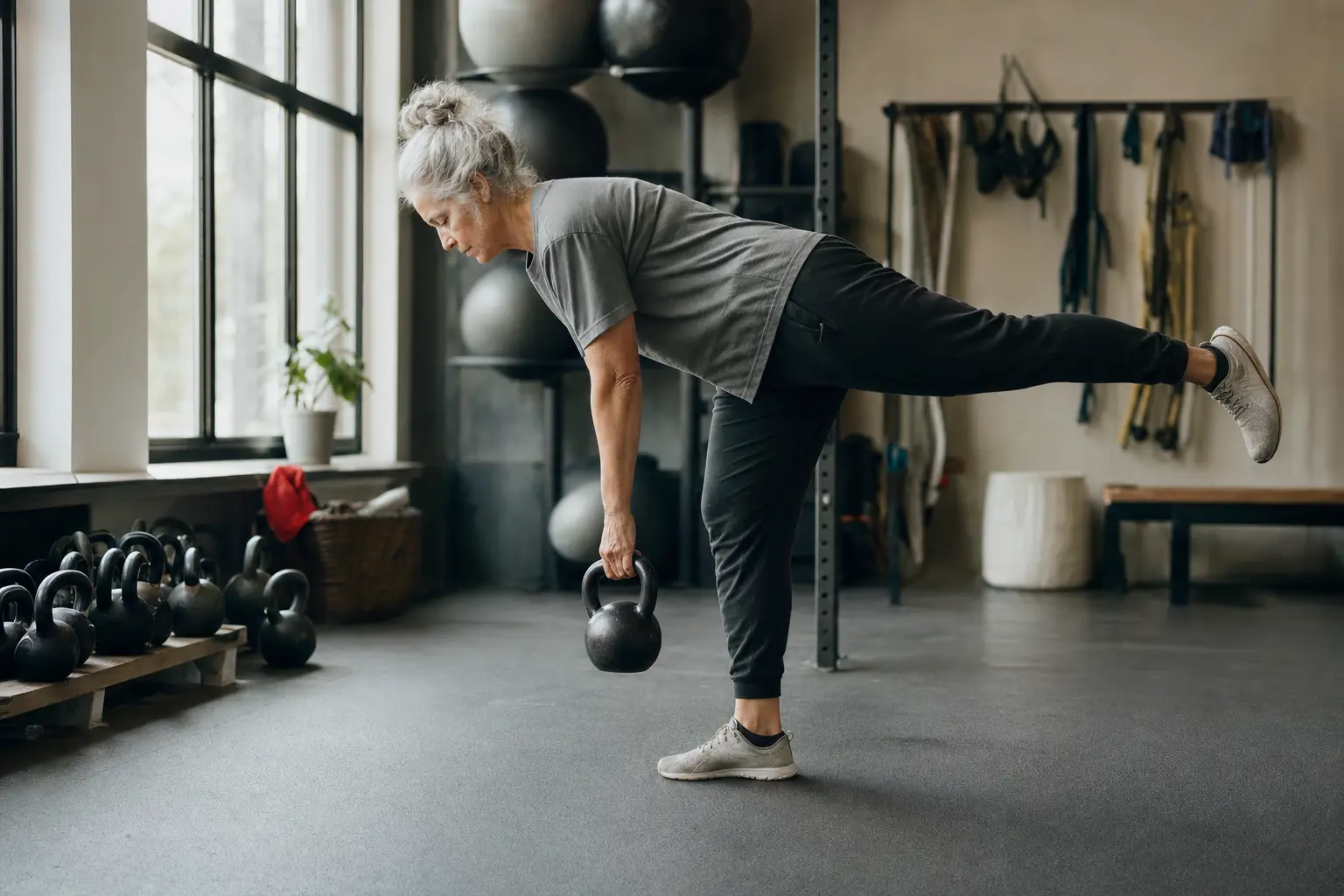
To do a single-leg RDL (single-leg Romanian deadlift), stand on one leg with a soft knee and hold a dumbbell or kettlebell. Push your hips back and let your free leg rise behind you as your chest tips forward, keeping your hips square and your back flat. Lower until you feel a stretch in the hamstring of your standing leg, then stand tall. If balance is the hard part, start with the B-stance RDL, where your back toes stay on the floor.
- Set your standing leg. Stand on one leg with your knee slightly bent. Hold the weight in the hand opposite your standing leg, or hold one in each hand.
- Hinge back. Push your hips straight back. Let your chest tip forward and your free leg rise behind you in one line, like a seesaw.
- Keep your hips square. Point the toes of your back foot at the floor so both hips face down. Keep the weight close to your standing leg.
- Stop at the stretch. Lower until you feel a strong stretch in the hamstring of your standing leg, or just before your back starts to round.
- Stand tall. Push your hips forward and squeeze the glute of your standing leg. Do all your reps on one side, then switch.
What a single-leg RDL is
A single-leg RDL is a Romanian deadlift done on one leg. You stand on one foot and push your hips back. Your chest tips forward while your free leg rises behind you. Then you stand tall again. People also call it a one-leg RDL or a single-leg Romanian deadlift.
Each leg works on its own, so you need much less weight than in a two-leg RDL. The hard part for most people is balance, not strength. That’s why the B-stance RDL is the best place to start.
Start with the B-stance RDL
The B-stance RDL (also called a split stance RDL) keeps both feet on the floor. Your front leg does most of the work. Your back foot is there only to keep you steady.
- Stand with your feet hip-width apart. Slide one foot back until its toes are level with the other heel.
- Lift the back heel, so only the toes and the ball of that foot touch the floor.
- Put most of your weight on the front leg. Push your hips back with a soft front knee and a flat back.
- Lower the weight down your front leg until your hamstring feels a strong stretch, then stand tall.
Hold a dumbbell in each hand, or hold one weight with both hands. When this feels steady, move on to the full single-leg RDL below.
Single-leg RDL form: a quick check
| Body part | What to aim for |
|---|---|
| Standing knee | A soft bend that stays the same from top to bottom |
| Hips | Both pointing at the floor. The free hip doesn’t open up to the side |
| Back and free leg | One straight line from your head to your back heel |
| Weight | Close to your standing leg, moving straight down and up |
| Depth | As low as your hamstring allows with a flat back |
Which hand holds the weight?
| Setup | What to know |
|---|---|
| One weight, opposite hand | The usual choice. Your side glute works harder to keep your hips level |
| One weight, same-side hand | Fine too. A hand is free on the other side to touch a wall or a rack |
| One weight in each hand | Lets you hold more in total, and the load is even on both sides |
| No weight | The place to start. Reach both hands toward the floor |
A 2023 study had 12 active men do single-leg RDLs with a dumbbell on each side in turn. Holding it in the hand opposite the standing leg gave higher activity in the side glute and the upper glute. Hamstring activity didn’t change much.
Balance tips
- Look at one spot on the floor a little way in front of you, and keep your eyes on it.
- Train in flat shoes or bare feet, and spread your toes so your whole foot grips the floor.
- Move slowly, and don’t rush the way down.
- Tap your back toes on the floor between reps until you no longer need to.
- Keep one hand near a wall or a rack, and touch it when you wobble.
Balance improves with practice. A 2026 position stand from the American College of Sports Medicine (ACSM) found that resistance training improved balance compared with no exercise.
What muscles does the single-leg RDL work?
The single-leg RDL works the hamstrings and glutes of your standing leg. The smaller glute muscles on the side of your hip work too, because they stop your hips from tipping.
In a 2023 study, 14 female footballers did eight hip exercises with and without weight. With weight, the single-leg RDL was in the top group for force in the gluteus maximus, which is the big glute muscle. It was also in the top group for the two smaller glute muscles on the side of the hip.
A 2021 study of 15 trained men compared a single-leg deadlift with the regular two-leg deadlift. On one leg, the side glute was more active (about 78% against 59%). So was one of the hamstring muscles (about 82% against 74%).
For more moves that train the side of the hip, see the best gluteus medius exercises. For the rest, see the best glute exercises.
Easier and harder versions
| Version | How |
|---|---|
| Easier: B-stance RDL | Back toes on the floor, most of your weight on the front leg |
| Easier: supported single-leg RDL | One hand on a wall or a rack, the weight in the other hand |
| Harder: slow lowering | Take three seconds to lower. Use less weight |
| Harder: more weight | A heavier dumbbell or kettlebell, or one in each hand |
Sets and reps to start with
Start with 2 or 3 sets of 8 to 12 reps on each leg, two days a week. The ACSM’s 2026 position stand found that strength improved with 2 to 3 sets and at least two sessions a week. Its 2009 guide suggests that beginners use weights they can lift for 8 to 12 reps, and that plans include moves for one leg as well as for both.
Do the same number of reps on each side. Rest 1 to 2 minutes between sets. When you can do one or two reps more than your target, the 2009 guide suggests adding 2 to 10%. With light dumbbells, that often means moving up to the next pair. Read more in progressive overload.
Common mistakes, and fixes
| Mistake | Try |
|---|---|
| Your free hip opens up to the side | Point your back toes at the floor and keep both hips facing down |
| Your back rounds as you reach for the floor | Stop higher. The weight only needs to reach your knee or shin |
| Your standing knee keeps bending | Set a soft bend at the top and hold it. Push your hips back, not down |
| You wobble on every rep | Go back to the B-stance RDL, or keep a hand on a wall |
Safety
Clear the floor around you, so you have room to step down if you lose your balance. Start with no weight and add it slowly. Warm up first (see how to warm up before lifting). If you feel sharp pain in your back or your standing leg, stop. See a doctor or a physical therapist before you do the lift again.
For another lift that trains one leg at a time, see the Bulgarian split squat.
Also asked
What is a B-stance RDL?
A B-stance RDL, also called a split stance RDL, is a Romanian deadlift with one foot a little behind the other. The front leg does most of the work and the back toes rest on the floor for balance. It's the easier step before the full single-leg RDL.
Which hand holds the weight in a single-leg RDL?
With one weight, hold it in the hand opposite your standing leg. In a 2023 study of 12 active men, holding the dumbbell there gave higher activity in the side glute and upper glute muscles than holding it on the same side as the standing leg. Hamstring activity was about the same either way.
What muscles does the single-leg RDL work?
The hamstrings and glutes of your standing leg. The muscles on the side of your hip also work to keep your hips level. In a 2023 study of 14 female footballers, the weighted single-leg RDL was in the top group of eight hip exercises for force in all the glute muscles.
Why can't I balance on a one-leg RDL?
Balancing on one leg while you hinge is a skill, and it takes practice. Look at one spot on the floor and keep a hand near a wall. The B-stance RDL lets you train the same muscles while your balance catches up.
Should I use a dumbbell or a kettlebell?
Either one. Use the weight you can hold without it pulling you off line. A 2026 position stand from the American College of Sports Medicine found that the type of equipment did not consistently change training results.
Is the single-leg RDL better than the regular RDL?
It's different more than better. You hold less weight, and each leg has to work on its own. In a 2021 study of 15 trained men, a single-leg deadlift showed more side glute activity than the regular two-leg deadlift, at about 78% against 59%.
How heavy should I go on single-leg RDLs?
Start with no weight at all. When you can do 10 steady reps on each leg, add a light dumbbell or kettlebell. Add weight only while your hips stay square and your back stays flat.
Sources
- Mo et al. (2023), Effects of loading positions on the activation of trunk and hip muscles during flywheel and dumbbell single-leg Romanian deadlift exercises
- Collings et al. (2023), Gluteal Muscle Forces during Hip-Focused Injury Prevention and Rehabilitation Exercises
- Diamant et al. (2021), Comparison of EMG Activity between Single-Leg Deadlift and Conventional Bilateral Deadlift in Trained Amateur Athletes - An Empirical Analysis
- Currier et al. (2026), American College of Sports Medicine Position Stand. Resistance Training Prescription for Muscle Function, Hypertrophy, and Physical Performance in Healthy Adults: An Overview of Reviews
- American College of Sports Medicine (2009), Progression models in resistance training for healthy adults