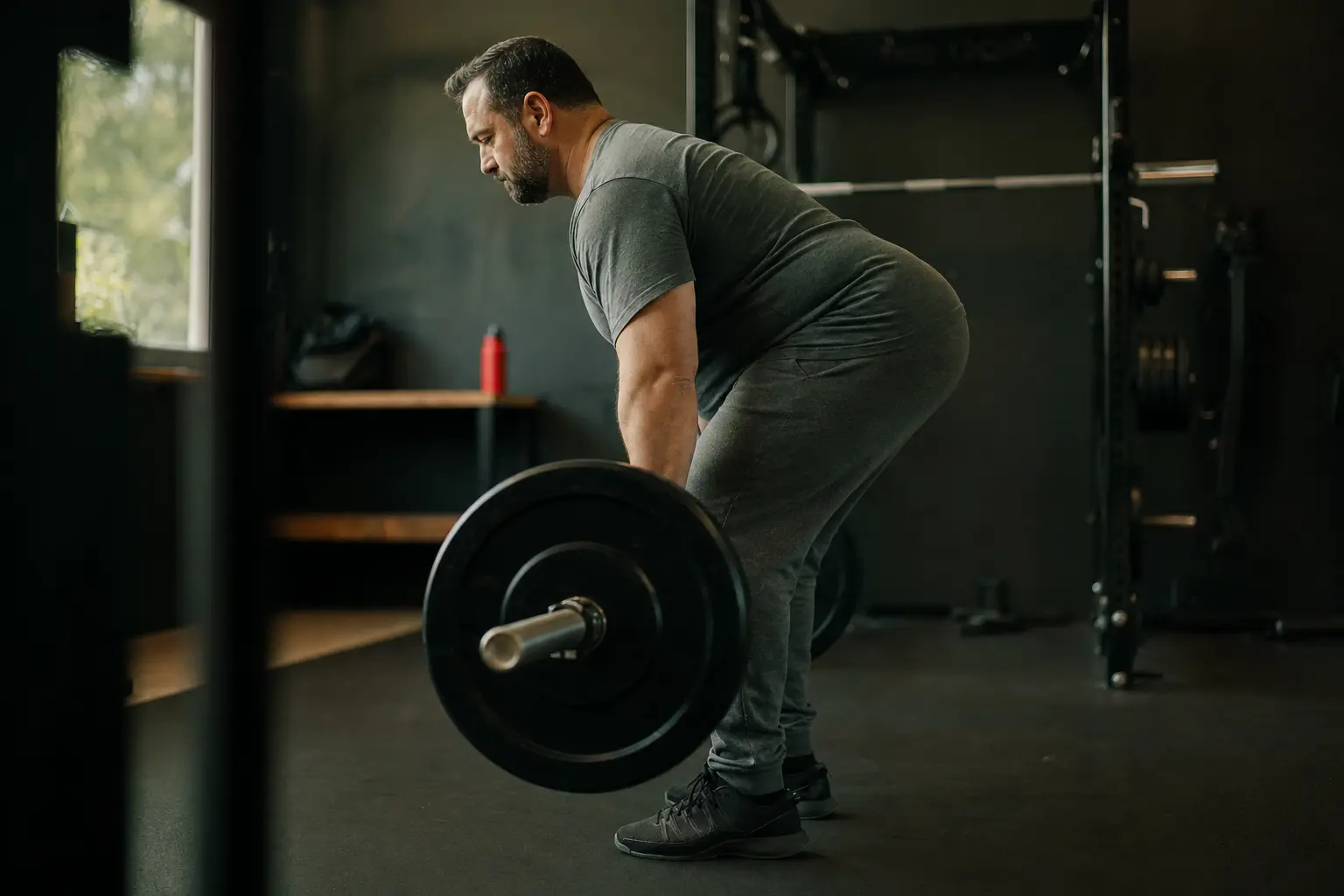
 AI-generated image
Guides · Strength training · Updated 2026-11-12
How do you do a Romanian deadlift (RDL)?
To do a Romanian deadlift (RDL), stand tall holding a barbell or two dumbbells against your thighs. Push your hips back with a soft bend in your knees and slide the weight down your legs until you feel a stretch in your hamstrings, keeping your back flat. Then push your hips forward and stand tall. Good RDL form means the weight stays close and your back never rounds, so start light.
- Start at the top. Take the bar from a rack set at mid-thigh height, or pick up two dumbbells. Stand tall with your feet hip-width apart and the weight against your thighs.
- Soften your knees. Bend your knees a little and keep them there. They stay soft for the whole rep and don't bend more as you go down.
- Push your hips back. Brace your core, then send your hips straight back as if you were closing a car door behind you. Your chest tips forward with a flat back.
- Slide the weight down your legs. Keep the weight brushing your thighs and shins. Stop when you feel a strong stretch in your hamstrings, or just before your back starts to round.
- Stand tall. Push your hips forward and squeeze your glutes to stand up. Finish tall without leaning back.
What a Romanian deadlift is
The Romanian deadlift, or RDL, is a hip hinge. You start standing tall with the weight in your hands. You push your hips back to lower it down your legs, then stand up again. Your knees stay slightly bent the whole time, and the weight doesn’t rest on the floor between reps.
That makes it different from the regular deadlift, which starts from the floor with more knee bend. The RDL is mostly a lift for the back of your body: your hamstrings and your glutes.
What muscles does the RDL work?
| Muscle | What it does in the RDL |
|---|---|
| Hamstrings (back of the thighs) | Stretch as you lower the weight, then pull your hips forward as you stand |
| Glutes | Push your hips forward to finish each rep |
| Lower back muscles | Hold your spine flat while you lean forward |
| Upper back and grip | Keep the weight close and in your hands |
In one study, 12 trained men did four hamstring exercises: the leg curl, the good morning, the glute-ham raise and the RDL. Hamstring activity was highest in the RDL and the glute-ham raise.
A 2020 review of deadlift studies found that in the Romanian deadlift, the lower back muscles were less active than the hamstrings. Your back still works to hold its position, so it can feel tired after hard sets.
RDL form: a quick check
| Body part | What to aim for |
|---|---|
| Feet | Hip-width apart, with your weight over the middle of your foot |
| Knees | A soft bend that stays the same from top to bottom |
| Hips | Travel straight back as you lower, then forward as you stand |
| Back | Flat from your head to your tailbone. Not rounded at the bottom |
| Bar or dumbbells | Brushing your thighs and shins the whole way |
| Depth | As low as your hamstrings allow with a flat back |
Film one set from the side with your phone. It’s the fastest way to check your back and the path of the weight.
RDL vs deadlift: what is the difference?
| Romanian deadlift | Deadlift | |
|---|---|---|
| Starts from | Standing tall | The floor |
| Knees | Slightly bent, and they stay there | Bend more, then straighten |
| Between reps | The weight stays off the floor | The weight rests on the floor |
| Works most | Hamstrings and glutes | The whole lower body and the back |
A 2018 study had 21 men do both lifts with the same weight. The regular deadlift worked the front of the thighs much harder: about 59% of peak activity, against 25% in the RDL. It also worked the glutes a little harder, at about 52% against 47%.
Neither lift is better. The deadlift spreads the work across more of your legs. The RDL keeps it on your hamstrings and glutes, with less for the front of your thighs. Many people do both. Learn the first one in how to deadlift.
Stiff-leg deadlift vs RDL
These two get mixed up. In a stiff-leg deadlift, your knees stay almost straight and your hips don’t travel back as far. In an RDL, your knees are soft and your hips push well back.
A 2022 study compared them in ten competitive bodybuilders. The RDL worked one of the hamstring muscles more than the stiff-leg deadlift did, and the stiff-leg deadlift worked the glutes more. Both train the same area, so use the one that feels better for your body.
Dumbbell, barbell, kettlebell and Smith machine RDLs
| Version | How to hold it | Good to know |
|---|---|---|
| Dumbbell Romanian deadlift | One in each hand, in front of your thighs | Easy to start with, at home or in a gym |
| Barbell RDL | Hands just outside your thighs, bar taken from a rack | The easiest one to load heavier over time |
| Kettlebell Romanian deadlift | One kettlebell in both hands, or one in each hand | The weight hangs between your legs or beside them |
| Smith machine RDL | Bar on its rails, feet set so the bar brushes your legs | The bar moves on a set path, so place your feet with care |
The movement is the same in all four. A 2026 position stand from the American College of Sports Medicine (ACSM) found that the type of equipment did not consistently change training results. Use what you have.
Easier and harder versions
- Easier: wall hinge. Stand a foot’s length in front of a wall, facing away from it. Push your hips back until they touch the wall. Use no weight.
- Easier: RDL to the knees. Lower the weight only to your kneecaps while you learn to keep your back flat.
- Harder: slow lowering. Take three seconds to lower the weight. Use less weight than usual.
- Harder: one leg at a time. Try the B-stance RDL first, then the single-leg RDL.
Standing on a low step lets the weight travel further. In the 2022 study, that raised glute and hamstring activity. It also asked more of the lower back, so leave it until your form is steady.
RDL alternatives
If the RDL doesn’t suit you, these train the same area:
- Back extension. The same hinge, with your legs held in place on a bench.
- Hip thrust or glute bridge. Your glutes push your hips up against the weight while your back rests on a bench or the floor.
- Cable pull-through. A hinge with a cable rope held between your legs. In a 2023 study, it gave less hamstring and lower back activity than the RDL at the same relative weight.
- Nordic hamstring curl. A body weight move for the hamstrings.
For more ideas, see the best glute exercises.
Sets and reps to start with
Start with 2 or 3 sets of 8 to 12 reps, two days a week. The ACSM’s 2026 position stand found that strength improved with 2 to 3 sets and at least two sessions a week. Its 2009 guide suggests that beginners use weights they can lift for 8 to 12 reps.
Pick a weight that leaves a rep or two in the tank. The 2009 guide suggests adding 2 to 10% when you can do one or two reps more than your target. Our guides to progressive overload and how many sets and reps build muscle cover the rest. Not sure where to start? See how much weight you should lift.
Common mistakes, and fixes
| Mistake | Try |
|---|---|
| Your back rounds near the bottom | Stop higher. Depth comes from your hips going back, not from reaching down |
| Your knees bend more as you lower | Set the knee bend at the top and hold it. Think “hips back”, not “sit down” |
| The weight drifts away from your legs | Keep it brushing your thighs. Pull your shoulders down and back |
| You lean back at the top | Stand tall and squeeze your glutes. That’s enough |
Safety
Warm up with a few lighter sets first (see how to warm up before lifting). Take a barbell from a rack set at mid-thigh, so you don’t have to lift it from the floor to begin. Keep the weight light until every rep looks the same. If you feel sharp pain in your back or your legs, stop. See a doctor or a physical therapist before you do the lift again.
Also asked
What muscles do RDLs work?
Mostly your hamstrings and your glutes. Your lower back muscles hold your spine flat, and your grip holds the weight. In a study of 12 trained men doing four hamstring exercises, hamstring activity was highest in the RDL and the glute-ham raise.
Are RDLs good for glutes?
Yes. Your glutes push your hips forward on every rep. In a 2018 study of 21 men, glute activity in the RDL was about 47% of peak, close to the 52% seen in the regular deadlift with the same weight. On a glute day, RDLs pair well with a lift such as the hip thrust.
What is the difference between an RDL and a deadlift?
A deadlift starts on the floor and uses more knee bend. An RDL starts standing with soft knees, and the weight stays off the floor between reps. In a 2018 study, the regular deadlift worked the front of the thighs much harder than the RDL did.
Is a stiff-leg deadlift the same as an RDL?
Not quite. In a stiff-leg deadlift your knees stay almost straight. In an RDL your knees are soft and your hips push further back. A 2022 study of ten competitive bodybuilders found the RDL worked one of the hamstring muscles more, and the stiff-leg deadlift worked the glutes more.
How low should I go on an RDL?
As low as you can with a flat back. Stop when your hamstrings feel a strong stretch or your hips stop moving back. The weight does not need to touch the floor.
Is a dumbbell Romanian deadlift as good as a barbell RDL?
For most people, yes. The movement is the same. A 2026 position stand from the American College of Sports Medicine found that the type of equipment did not consistently change training results. A barbell is easier to load heavier later on.
What does RDL stand for?
RDL stands for Romanian deadlift. People use both names for the same lift.
How heavy should I go on RDLs?
Start with light dumbbells or an empty bar. Pick a weight you can lift for 10 clean reps with 2 or 3 more left. The American College of Sports Medicine suggests adding 2 to 10% when you can do one or two reps more than your target.
Sources
- McAllister et al. (2014), Muscle activation during various hamstring exercises
- Lee et al. (2018), An electromyographic and kinetic comparison of conventional and Romanian deadlifts
- Coratella et al. (2022), An Electromyographic Analysis of Romanian, Step-Romanian, and Stiff-Leg Deadlift: Implication for Resistance Training
- Martín-Fuentes et al. (2020), Electromyographic activity in deadlift exercise and its variants. A systematic review
- Dicus et al. (2023), A Comparison of Muscle Recruitment Across Three Straight-Legged, Hinge-Pattern Resistance Training Exercises
- Currier et al. (2026), American College of Sports Medicine Position Stand. Resistance Training Prescription for Muscle Function, Hypertrophy, and Physical Performance in Healthy Adults: An Overview of Reviews
- American College of Sports Medicine (2009), Progression models in resistance training for healthy adults