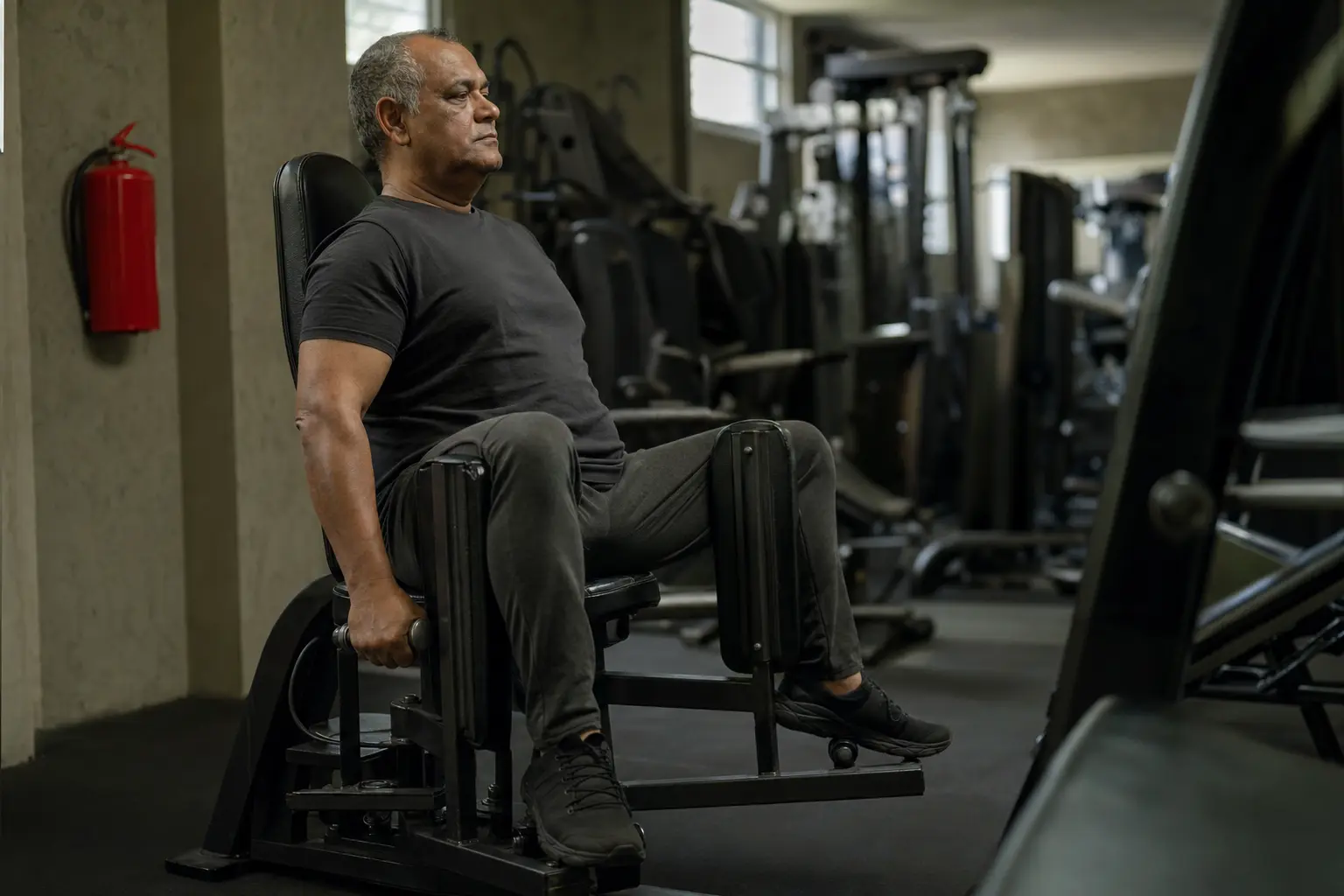
 AI-generated image
Guides · Strength training · Updated 2026-11-12
How do you use the hip abduction machine?
To use the hip abduction machine, sit with your back against the pad and the leg pads against the outside of your knees. Push your knees apart as far as you comfortably can and pause, then bring them back slowly without letting the weights touch down. Start with 2 or 3 sets of 8 to 12 reps, twice a week. Hip abduction works the muscles on the side of your hips, mainly the gluteus medius.
- Set the pads and the weight. Move the leg pads so they start close together. Pick a light weight for your first set, so you can learn the move.
- Sit tall. Sit with your back against the pad and your feet on the footrests. Rest the outside of each knee against a leg pad and hold the handles.
- Push your knees apart. Push out against the pads as far as you comfortably can. Take one to two seconds, and keep your hips on the seat.
- Pause, then come back slowly. Hold for a moment at the widest point. Let the pads come back together over one to two seconds, and stop just before the weights touch.
- Repeat. Do 8 to 12 reps. Rest 1 to 2 minutes, then do your next set.
What the hip abduction machine is
The hip abduction machine is a seat with two padded arms that rest against the outside of your knees. You push your knees apart against the weight, then bring them back together slowly. Some gyms call it the seated hip abduction machine.
It trains one movement, so it’s quick to learn and easy to make a little heavier over time. Most people use it near the end of a leg day or a glute workout.
Hip abduction vs adduction
Hip abduction means moving your leg out to the side, away from the middle of your body. Hip adduction is the opposite: bringing your leg back in toward the middle.
| Hip abduction | Hip adduction | |
|---|---|---|
| The movement | Knees push apart | Knees squeeze together |
| Where the pads sit | Outside of your knees | Inside of your knees |
| Main muscles | Side of the hips: gluteus medius and gluteus minimus | Inner thighs: the adductors |
Many gyms have one machine for each. Others have a single machine where you turn the pads around to switch. The two moves train opposite sides of the hip, so there’s room for both in a week.
Hip abduction machine muscles worked
| Muscle | Where it is | What it does here |
|---|---|---|
| Gluteus medius | Side of the hip | The main mover. It lifts the leg out to the side |
| Gluteus minimus | Under the gluteus medius | Helps with the same job |
| Upper gluteus maximus | Top of the buttock | Helps, more so when your hips are bent |
| Tensor fasciae latae | Front corner of the hip | Helps, less so when your hips are bent |
Can it build muscle? A 2026 study had 17 young adults train one leg with cable hip abduction twice a week for 10 weeks. The upper part of the gluteus maximus grew about 10%. The gluteus medius and gluteus minimus together grew about 4%. The other leg did a cable hip extension, and that grew the gluteus maximus more overall, 9% against 5%.
So hip abduction is a good extra for the upper and outer glutes. It works best next to bigger lifts such as the hip thrust and the Romanian deadlift. The study used a cable and not the seated machine. Your own results will differ. See how long it takes to see results.
Should you lean forward or sit back?
Both work. A lab study of 27 men measured the hip muscles while they pushed one leg out to the side, with the hip bent at different angles. The more the hip was bent, the harder the gluteus maximus worked and the less the tensor fasciae latae did. The gluteus medius worked about the same at every angle.
Leaning forward bends your hips more, so it may move a little of the work toward the upper glutes. That study didn’t use a gym machine, so treat it as a hint. Sit back against the pad while you learn the move. If you lean forward later, keep your back flat and use the same position every set, so your numbers compare.
Common mistakes, and what to try
| Mistake | Try |
|---|---|
| Letting the weights crash back | Take one to two seconds to come back, and stop just before the weights touch |
| Short, fast reps with too much weight | Drop the weight and push out as far as you comfortably can |
| Rocking your body to start each rep | Hold the handles and keep your hips on the seat |
| Changing your position from set to set | Pick upright or leaning forward, then stay with it |
Hip abduction exercises without a machine
No machine, or the machine is taken? These four train the same movement.
| Exercise | What you need |
|---|---|
| Cable hip abduction | A low cable and an ankle strap |
| Standing hip abduction | A loop band and a wall |
| Side lying hip abduction | A mat |
| Seated band hip abduction | A loop band and a bench or chair |
Cable hip abduction. Strap the cable to the ankle farther from the machine and stand side-on, holding the frame. Stand tall and lift that leg out to the side, then lower it slowly. A cable version was the one used in the 10-week study above.
Standing hip abduction. Put a loop band around your ankles and rest one hand on a wall. Lift one leg out to the side without leaning over, then lower it. In a study of 16 women who were new to training, a band version of hip abduction worked the gluteus medius harder than the machine did.
Side lying hip abduction. Lie on your side with your bottom knee bent. Keep your top leg straight with your toes pointing forward. Lift it, then lower it slowly. In a study of 21 active adults, this move came out best for the gluteus medius of the 12 exercises tested, at about 81% of the most the muscle could do in a test.
Seated band hip abduction. Sit on a bench with a loop band just above your knees and your feet flat. Push your knees apart and pause, then bring them back slowly. It’s the closest match to the machine.
A review of 23 studies found some of the highest gluteus medius activity in two of these moves: side lying hip abduction and standing hip abduction with a band at the ankles. The side plank with hip abduction scored high as well. You’ll find it in the best gluteus medius exercises.
How many sets and reps
Start with 2 or 3 sets of 8 to 12 reps, twice a week. A 2026 position stand from the American College of Sports Medicine (ACSM) advises at least two sets per exercise and training at least twice a week. Its 2009 guide suggests 8 to 12 reps for people who are new to lifting, with 1 to 2 minutes of rest between sets when the goal is muscle.
Pick a weight that lets you finish every rep with control. When you can do one or two reps more than your target, add 2 to 10%. Our guides to progressive overload and how many sets and reps build muscle cover the next steps.
The same 2009 guide advises doing lifts that use many joints before lifts that use one. So do your squats and hip thrusts first, then hip abduction. The best glute exercises shows where each move fits.
Safety
Start lighter than you think you need, and never force the pads wider than your hips want to go. Stop if you feel sharp pain in your hip or groin. If it keeps coming back, see a doctor or physical therapist before you train it again. This guide covers training only, not the care of an injury.
Also asked
What muscles does the hip abduction machine work?
Mostly the gluteus medius and the gluteus minimus, on the side of your hips. The upper part of the gluteus maximus helps. So does the tensor fasciae latae, a small muscle at the front corner of the hip.
What is the difference between hip abduction and adduction?
Hip abduction moves your leg out to the side, away from the middle of your body. Hip adduction brings it back in. On the abduction machine you push your knees apart. On the adduction machine you squeeze them together, which works the inner thighs.
Should I lean forward or sit back on the hip abduction machine?
Either is fine. In a lab study of 27 men, the gluteus maximus worked harder as the hip bent more. The gluteus medius worked about the same at every angle. Sit back while you learn. If you lean forward later, do it the same way every set.
Does the hip abduction machine grow your glutes?
Hip abduction can add some muscle to the upper and outer glutes. In a 2026 study, 17 young adults did cable hip abduction twice a week for 10 weeks. The upper part of the gluteus maximus grew about 10%, and the gluteus medius and minimus together grew about 4%. In the same study, a hip extension exercise grew the gluteus maximus more overall, 9% against 5%. Results differ from person to person.
How much weight should I use on the hip abduction machine?
Start with a weight you can move for 8 to 12 smooth reps. When you can do one or two reps more than your target, add 2 to 10%, as the American College of Sports Medicine suggests.
What can I do instead of the hip abduction machine?
Try cable hip abduction, standing hip abduction with a loop band, side lying hip abduction or a seated version with a band above your knees. In one study, side lying hip abduction came out best for the gluteus medius of the 12 exercises tested.
How often should I do hip abduction?
Twice a week is a good start. A 2026 position stand from the American College of Sports Medicine advises at least two sets per exercise and training at least twice a week.
Sources
- Attarieh et al. (2026), Regional Hypertrophy of the Gluteal Muscles Is Task-Specific: Differential Responses to 10 Weeks of Hip Extension Versus Hip Abduction Training
- Fujisawa et al. (2014), Hip Muscle Activity during Isometric Contraction of Hip Abduction
- Brandt et al. (2013), Perceived loading and muscle activity during hip strengthening exercises: comparison of elastic resistance and machine exercises
- Distefano et al. (2009), Gluteal muscle activation during common therapeutic exercises
- Macadam et al. (2015), An examination of the gluteal muscle activity associated with dynamic hip abduction and hip external rotation exercise: a systematic review
- Flack et al. (2012), A review of the anatomy of the hip abductor muscles, gluteus medius, gluteus minimus, and tensor fascia lata
- Currier et al. (2026), American College of Sports Medicine position stand: Resistance training prescription for muscle function, hypertrophy, and physical performance in healthy adults
- American College of Sports Medicine (2009), Progression models in resistance training for healthy adults
- OpenStax, Anatomy and Physiology 2e, 9.5 Types of Body Movements
- OpenStax, Anatomy and Physiology 2e, 11.6 Appendicular Muscles of the Pelvic Girdle and Lower Limbs