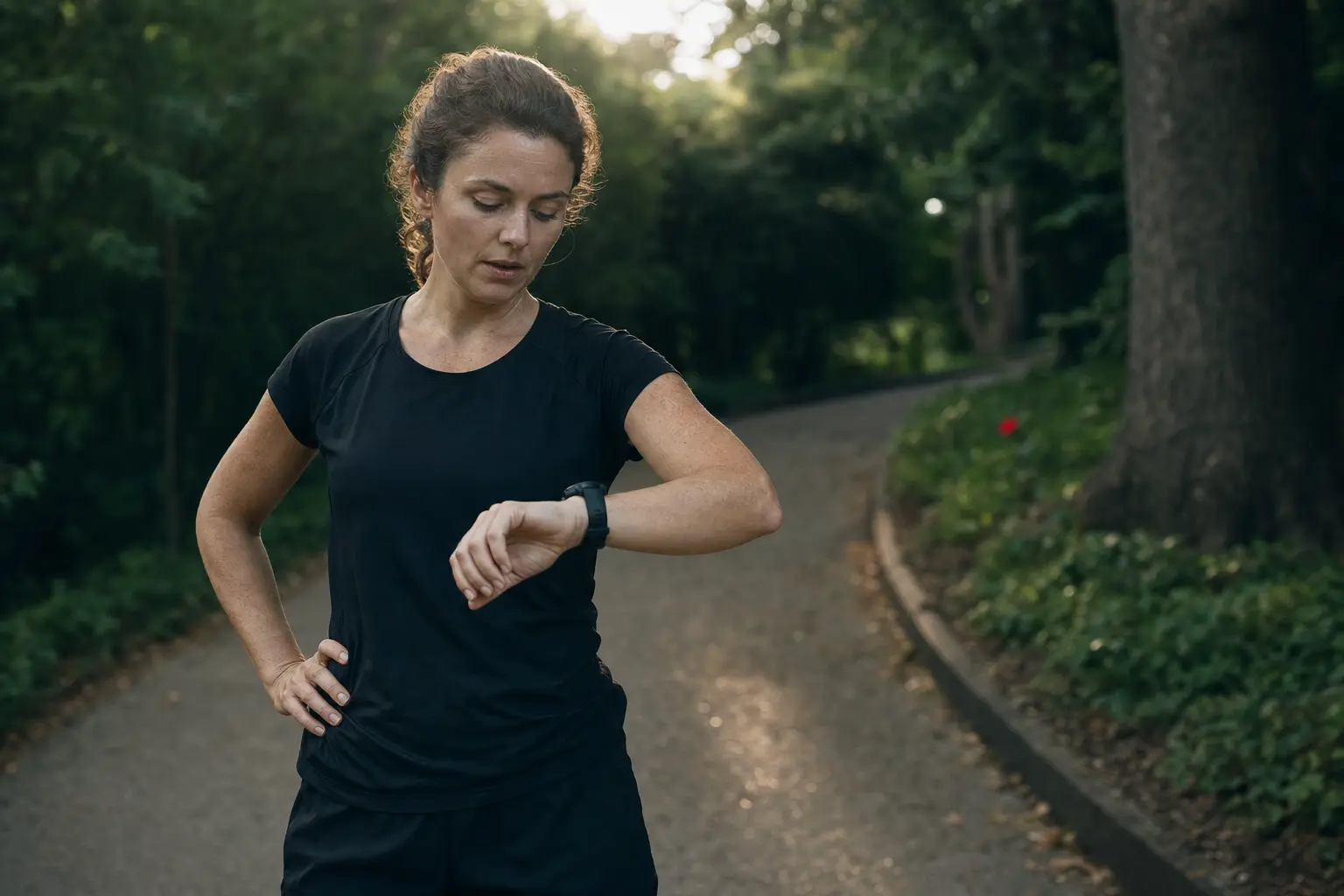
 AI-generated image
Guides · Strength training · Updated 2026-11-01
Are Apple Watch and Garmin calories accurate?
They're rough estimates. Wrist devices measure heart rate well, but in a Stanford study of seven of them, none got within 20 percent on calories burned, and a 2025 review of 56 Apple Watch studies found an average calorie error of about 28 percent. Reviews of Garmin watches find similar gaps. Use your watch's calories to compare one day or week with another, not as an exact number to eat back.
- Keep your profile up to date. Check that your weight and height are right in your watch settings. The calorie estimate leans on them, so update your weight when it changes.
- Wear it snug. Wear the watch snug enough that it doesn't slide around. A loose watch reads heart rate less well.
- Compare like with like. Use the number to compare your own days and weeks: this week's runs against last week's, or a walk day against a rest day.
- Let your weight trend decide. If you eat back exercise calories, check your weekly average weight after a few weeks. If it isn't moving the way you want, eat a little less, whatever the watch says.
The short answer
Every wrist device estimates calories. None of them measures calories directly. In lab studies, watches get heart rate close, often within about 5 percent. Calories are a different story: the error is usually 20 to 30 percent or more.
That doesn’t make the number useless. It means the number is good for spotting trends in your own activity, and not good as an exact amount to eat back.
How researchers test watch calories
To know what you really burned, a lab measures the oxygen you breathe in and the carbon dioxide you breathe out. This is called indirect calorimetry. Researchers put people through set activities while wearing the watch and the lab equipment, then compare the two numbers.
A watch can’t do that from your wrist. It works out calories from what it can sense, such as your heart rate and movement, plus the details you gave it, such as your weight. One of the Stanford researchers explained that calories burned depend on things like fitness and body size, so one formula is hard to get right for everyone.
What the studies found
Here are the main studies, with what each found on calories:
| Study | Who and what | Calorie results |
|---|---|---|
| Stanford, 2017 | 60 adults, seven wrist devices, sitting, walking, running and cycling | No device got within 20 percent. The lowest median error was 27 percent, and the highest was 93 percent. The Apple Watch had the best overall results across heart rate and calories. |
| Review, 2020 | 158 studies of nine brands | No brand was accurate for calories. No brand was within 3 percent more than 13 percent of the time. |
| Garmin review, 2020 | 12 studies of Garmin devices | Errors were mostly outside acceptable limits, some high and some low. |
| Outdoor study, 2022 | 20 adults walking and running outside | Apple Watch Series 6: 20 percent off walking, 24 percent running. Garmin Fenix 6: 32 percent walking, 22 percent running. Huawei Watch GT 2e: 10 percent walking, 12 percent running. |
| Apple Watch review, 2025 | 56 studies of the Apple Watch | Calories were about 28 percent off on average, compared with about 4 percent for heart rate and 8 percent for steps. |
A few things stand out:
- Heart rate is the strong point. The 2020 review found the Apple Watch and Garmin were the most accurate brands for heart rate. In the Stanford study, the Apple Watch was within about 2 percent.
- Calories vary by study. Each device did better in some tests and worse in others. The 2022 study was small, so one result there is not the final word.
- Newer models are a little better. The 2025 review found newer Apple Watch models did slightly better than older ones, though not by a big jump each year.
- Error isn’t the same for everyone. In the Stanford study, error was higher during walking, for men, for people with a higher BMI and for people with darker skin.
Does your watch read high or low?
It can go either way. The 2020 review found Apple devices read high in 58 percent of comparisons, and Garmin devices read low in 69 percent. But in the 2022 outdoor study, both the Apple Watch and the Garmin read high on walks and runs. The 2020 Garmin review found readings that were too high and too low.
So you can’t assume your watch is always high or always low. The safest plan is to treat its number as a rough guide.
How to use watch calories well
Researchers who ran these studies point the same way: use the watch as a guide to your habits, not as an exact measure. The Garmin review said wrist devices may only be able to pick up big changes in calories burned.
That still makes the number useful:
- Compare against yourself. A day with a long walk should show more than a rest day. A week with more workouts should show more than a quiet week.
- Watch your weight trend. Your weekly average weight is the real test of whether you’re eating the right amount. Our guide to how many calories to eat to lose weight covers how to set a target, and our TDEE calculator gives you a starting point.
- Be careful eating back calories. If your watch reads high, eating back every calorie can stall weight loss. If you’ve hit a stall, our guide to a weight loss plateau can help.
- Don’t chase a bigger number. Getting more calories on your watch isn’t the goal. Moving more and recovering well is.
For a gym session, you can also estimate calories from the activity itself. Our treadmill calorie calculator and cardio calorie calculator work it out from your weight and the workout. Those are estimates too. Our guide to calories burned lifting weights covers strength days.
Ways to get a closer reading
- Keep your details current. Your weight and height go into the estimate.
- Wear it snug. A loose band reads heart rate less well, and heart rate feeds the calorie number.
- Try a chest strap. The 2020 Garmin review found a chest strap measured heart rate more closely than a wrist sensor.
- Pick the right workout type. Starting a workout on the watch, such as a run or a strength session, tells it what you’re doing.
None of these makes the number exact, but they help the watch work from better inputs.
Also asked
Are Apple Watch calories accurate?
Not exactly. A 2025 review of 56 studies found the Apple Watch was off by about 28 percent on calories on average, while heart rate was off by only about 4 percent. Newer models did a little better than older ones. In the 2017 Stanford study, the Apple Watch had the best overall results of seven devices, but no device got within 20 percent on calories.
How accurate is Garmin calories burned?
Garmin calorie numbers are estimates with a wide margin, like other wrist devices. A 2020 review of 12 studies found Garmin calorie errors were mostly outside acceptable limits, with some readings too high and some too low. In a 2022 outdoor study, a Garmin Fenix 6 was off by about 32 percent on walks and about 22 percent on runs. Use it to compare your own workouts, not as an exact count.
Do smartwatches overestimate or underestimate calories?
It can be either. It depends on the watch and on what you're doing. One large 2020 review found Apple devices read high in 58 percent of comparisons and Garmin devices read low in 69 percent. But in a 2022 outdoor study, both an Apple Watch and a Garmin read high. You can't safely assume your watch errs one way.
Should I eat back the calories my watch says I burned?
Treat them as a rough guide. One careful approach is to eat back only part of them, then check their weekly average weight after a few weeks. If your weight isn't moving the way you want, adjust what you eat and give it two more weeks.
Which smartwatch is most accurate for calories?
No wrist device in these studies met the researchers' accuracy targets for calories. Results vary by study: the Apple Watch had the best overall profile in the 2017 Stanford study, while a Huawei watch came closest in one small 2022 outdoor study. Whichever watch you have, use the same one and compare against yourself.
Does a chest strap make calorie counts more accurate?
A chest strap measures heart rate more closely than a wrist sensor, which a 2020 review of Garmin studies confirmed against an ECG. Calories are still an estimate worked out from heart rate and your details, so a strap helps the input but doesn't make the calorie number exact.
Sources
- Shcherbina et al. (2017), Accuracy in wrist-worn, sensor-based measurements of heart rate and energy expenditure in a diverse cohort (Journal of Personalized Medicine)
- Fuller et al. (2020), Reliability and validity of commercially available wearable devices for measuring steps, energy expenditure, and heart rate, systematic review (JMIR mHealth and uHealth)
- Evenson and Spade (2020), Review of validity and reliability of Garmin activity trackers (Journal for the Measurement of Physical Behaviour)
- Le et al. (2022), Validity of three smartwatches in estimating energy expenditure during outdoor walking and running (Frontiers in Physiology)
- University of Mississippi (2025), Study examines how well wearable tech tracks fitness metrics (Kang and Choe meta-analysis of 56 Apple Watch studies)
- The Stanford Daily (2017), Fitness trackers vary widely in accuracy, researchers find